
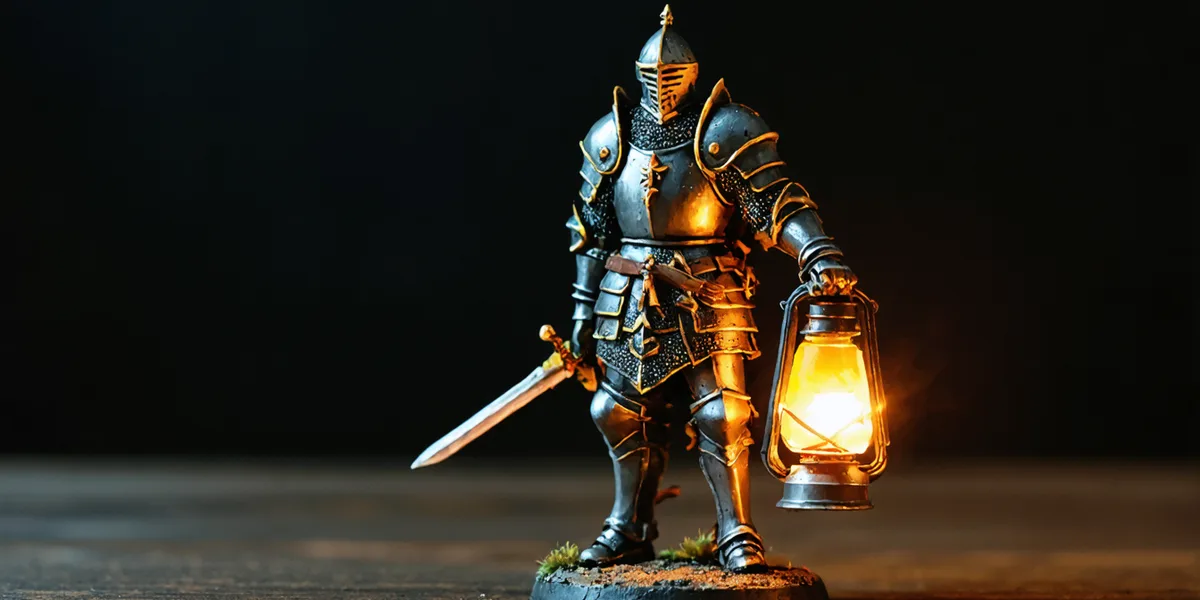
OSL, short for object source lighting, is painting light that comes from something on the model itself: a lantern, a glowing sword, plasma coils, eye lenses, a campfire on the base. You paint the source as the brightest point, then paint its light falling on everything near it, fading with distance. Done well, a static model looks lit from within.
The paints that carry most OSL work are bright glazes and fluorescents. Some of the most used, with prices from the shops we track in your market:
AK Interactive
Citadel (Warhammer Paints)
Citadel (Warhammer Paints)
How light behaves, which is what OSL copies
Three rules cover most of it.
- The source is the brightest thing on the model, close to white. Pure colour is never as bright as white with a tint, so the hottest point of a flame or a plasma coil is a pale, almost white version of its colour.
- Light falls off with distance. Surfaces right next to the source catch strong light; a hand's width away they catch a little; further still, none. A soft, quick fade sells it more than the colour does.
- Light only lands on surfaces that face the source. The side of a face turned towards a lantern lights up; the other side stays in shadow. Under-surfaces lit from below (a campfire, a glowing base) are the classic dramatic look.
The surfaces the light lands on also keep their own colour. A green glow on red armour reads as a mix, not as pure green, which is why OSL is usually glazed on in thin layers rather than painted opaque.
What you need
- A darker scheme around the source. OSL reads best where the rest of the model is muted or dark. Bright models in daylight colours have nothing for the glow to contrast against.
- A white or very pale paint, for the source itself.
- A glow colour: a bright layer paint, a translucent contrast or speed paint, or a fluorescent.
- A fine brush, and a wet palette helps a lot with the thin glazes. See the wet palette guide.
Why fluorescents? Fluorescent paints are more saturated than ordinary pigments, so a glaze of them over a pale area looks brighter than the same hue in a normal paint. Most painters use them sparingly, for the strongest part of the glow, and use ordinary paints for the rest. Every major range sells some, and you can match one against your own paints in the paint matcher.
AK Interactive
AK Interactive
AK Interactive
How to paint OSL, step by step
- Finish the model's own colours first, a little darker than you would normally. The glow will brighten everything near the source.
- Paint the source white or near-white. The lens, the blade core, the flame centre.
- Glaze the glow colour over the source, thin, so the white still shows through at the centre and the colour is richer at the edges.
- Glaze the glow onto surrounding surfaces, thinned right down, only on the faces that point at the source. Several very thin layers, each covering a smaller area closer to the source.
- Add the brightest highlights last. A pale mix of the glow colour and white on the edges nearest the source, which sells the strength of the light.
- Check it at arm's length and in a photo. OSL can look subtle up close and vanish at table distance; if it does, the falloff is too gradual. Strengthen the area closest to the source.
An airbrush makes step 4 much faster, because a low-pressure spray gives a smooth gradient on its own. See airbrush thinner for thinning fluorescents to spray.
Recipes: four glows, four ranges
Green plasma or warp-glow. Citadel: White Scar source, Moot Green over it, then Tesseract Glow glazed outwards. Vallejo: white, then Fluorescent Green glazed outwards. AK: white, then Fluorescent Green.
Blue power field or lens. Citadel: White Scar, Baharroth Blue, then Aethermatic Blue as the glaze. Vallejo: white, then Fluorescent Blue. Army Painter: white, then Magic Blue Speedpaint as the glaze.
Fire, torches and lanterns. Light from flame is yellow at the centre and orange to red as it fades. Citadel: White Scar, Dorn Yellow, Flash Gitz Yellow, then Gryph-Hound Orange glazed outwards. Vallejo: Fluorescent Yellow, then Fluorescent Orange, with Fluorescent Red at the very edge of the glow.
Gems and small lenses. These are a tiny OSL: dark at the top, light at the bottom, with a white dot of reflection at the top. Citadel's gloss Technical gem paints, Soulstone Blue, Waystone Green and Spiritstone Red, do it in one coat over a white or silver base.
Citadel (Warhammer Paints)
Citadel (Warhammer Paints)
Citadel (Warhammer Paints)
Citadel (Warhammer Paints)
Citadel (Warhammer Paints)
Citadel (Warhammer Paints)
Common mistakes and fixes
- Glow on the wrong faces. Light cannot reach the far side of an arm. Picture a line from the source to each surface before you glaze it.
- No falloff. An even wash of glow colour over a whole area reads as a green paint job. A quick fade is what makes it read as light. Make the fade quick and strongest nearest the source.
- Source not bright enough. If the source is the same brightness as the glow around it, nothing reads as a light. Take the centre to white.
- Too much fluorescent. Fluorescents look garish over large areas. Keep them to the hottest part of the glow.
- Everything around it is bright. OSL needs darkness to show. Knock back the surroundings with a wash or a dark glaze before adding the light.
Questions people ask
What does OSL stand for in painting? Object source lighting: light painted as coming from an object on the model, rather than from the sky or a lamp above.
What paint is best for OSL? Thin glazes or translucent paints for the glow, a white for the source, and fluorescents for the brightest part. Citadel Contrast, Army Painter Speedpaint and Vallejo's fluorescents are all popular.
Do I need an airbrush for OSL? No. An airbrush makes smooth glows faster, but thin glazes by brush, as in wet blending, give the same result with more control.
Is OSL hard? The idea is simple; the patience is the hard part. Start with a small source, such as an eye lens or a gem, before trying a lantern lighting a whole face.
Fluorescent paints for OSL
A white and one fluorescent in the glow colour are enough to start.
We earn a small commission from qualifying purchases at no extra cost to you.