
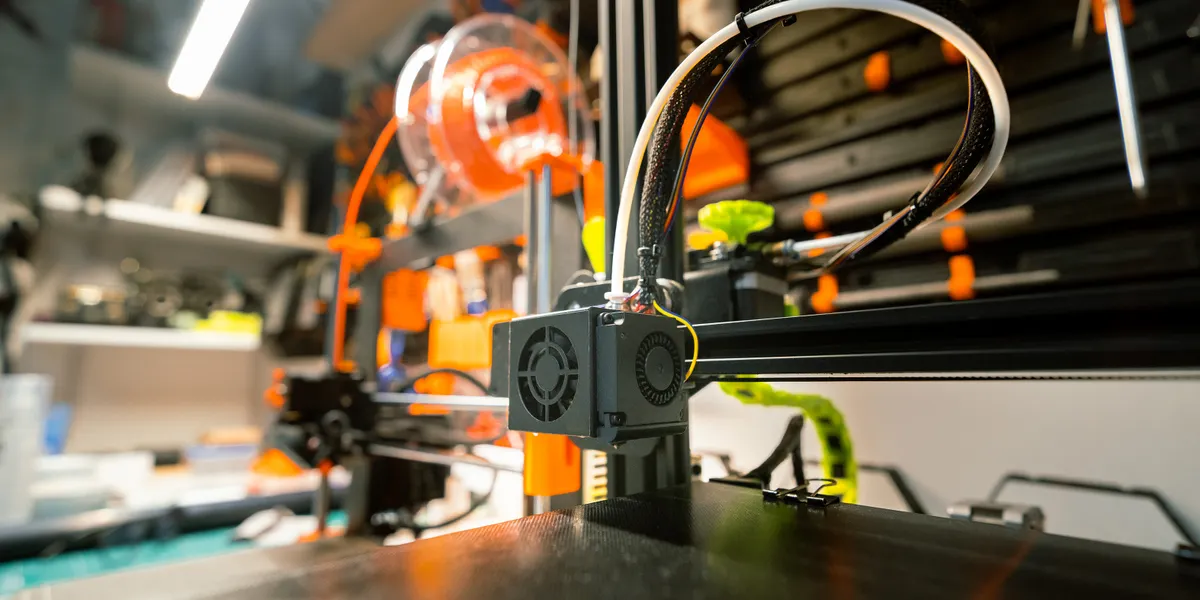
Print terrain, scatter and bases in PLA unless a piece has to survive heat or knocks that would break PLA. ABS is far tougher and copes with more heat, but it warps as it cools, gives off fumes, and its makers want it printed in an enclosed chamber. If your printer is open, PLA (or PETG) is the answer. These are 1 kg spools of each, in grey and black, the neutral colours for anything you will prime and paint, from brands several of the shops we track sell:

PLA filament: the easiest material for terrain, scenery, props and display pieces · 1kg
ELEGOO

Standard PLA filament: the easiest material for terrain, props and display pieces · 1kg
SUNLU

1.75 mm PLA filament for FDM printers · 1kg spool, 1.75 mm
eSUN

ABS filament: tougher and more heat-resistant than PLA, needs a heated bed and ideally an enclosure · 1kg
ELEGOO

ABS-family filament: tougher and more heat-resistant than PLA, needs a heated bed and ideally an enclosure · 1kg, 1.75 mm
Creality

ABS filament: tougher and more heat-resistant than PLA, needs a heated bed and ideally an enclosure · 1kg
SUNLU
Every spool is on the PLA filament page and the ABS and ASA shelf, priced per kilo in your currency. The print settings for both, and fourteen other filaments, are in our filament temperature chart.
PLA vs ABS at a glance
| PLA | ABS | |
|---|---|---|
| Nozzle temperature (eSUN) | 210-230 °C | 255-275 °C |
| Bed temperature (eSUN) | 45-60 °C | 95-110 °C |
| Part cooling fan (eSUN) | 100% | Off |
| Enclosure | Not listed: eSUN asks for a heated bed only | eSUN: enclosed-chamber printing; Prusa: "should be inside an enclosure" |
| Heat distortion (eSUN) | 54 °C | 78 °C |
| Impact strength, Izod (eSUN) | 3.3 kJ/m² | 26.5 kJ/m² |
| Fumes | Not raised by either maker | Prusa lists "toxic fumes" as a main disadvantage |
| Smoothing | Sand wet (Prusa) | Sands wet or dry, smooths with acetone vapour (Prusa) |
| Best for | Most terrain, scatter, bases and display pieces | Tough, heat-tolerant parts on an enclosed printer |
The PLA figures are from eSUN's PLA-Basic page and the ABS figures from its ABS page: both from the "Recommended Printing Parameters" and "Physical Performance" tables. The Prusa lines are from its PLA and ABS material articles. Other brands print in similar ranges; the label on your spool is the setting to start from.
Why PLA is the default
PLA prints at the lowest temperatures of the common filaments, on a bed no hotter than 60 °C, with the part fan at full. It barely warps, so a long, flat terrain wall stays flat without an enclosure or a brim. That is why most terrain, crates, ruins and bases are printed in it, and why Prusa describes it as the material for concept models, prototypes and "low-wear toys".
Its weakness is heat and impact. Prusa says PLA "gets soft and deforms at temperatures over 60 °C", and eSUN measures its heat distortion at 54 °C. A thin PLA spire snaps rather than bends.
Where ABS earns its place
ABS is the tough one. On eSUN's own measurements its Izod impact strength is about eight times that of eSUN PLA-Basic, and its heat distortion temperature is 78 °C against 54 °C. Prusa recommends it for "cheap technical parts requiring good heat and mechanical resistance". For a wargamer that means parts that take knocks: transport-case hardware, clips and hinges, and terrain that lives in a hot car boot.
It also finishes differently. Prusa notes ABS "can be sanded wet and dry and smoothed with acetone fumes", which melts the layer lines into a glossy surface. That suits a smooth sci-fi hull or a vehicle panel, though vapour smoothing softens fine detail too. Sanding and filling either plastic is covered in our guide to sanding 3D prints.
ABS filament: tougher and more heat-resistant than PLA, needs a heated bed and ideally an enclosure · 1kg
ELEGOO

ABS-family filament: tougher and more heat-resistant than PLA, needs a heated bed and ideally an enclosure · 1kg, 1.75 mm
Creality

ABS filament: tougher and more heat-resistant than PLA, needs a heated bed and ideally an enclosure · 1kg
QIDI Tech
The catch: enclosure, warping and fumes
ABS needs a hot chamber. eSUN's printing recommendation for ABS is enclosed-chamber printing with the part fan off, and Prusa says the printer "should be inside an enclosure with a higher ambient temperature". Without one, the corners of a big print lift and the layers crack as it cools. Prusa names warping and toxic fumes as ABS's main disadvantages and says to print it in a well-ventilated room, without a draft across the print.
An enclosure for an open printer is usually a fold-up tent that sits over the whole machine (do you need a 3D printer enclosure compares tents and rigid boxes). Measure your printer, including the spool holder and the bed's full travel, before choosing a size; the Elegoo one is made for its Neptune printers.

3D printer enclosure · Small
Creality
3D printer enclosure · Medium
Creality

Fold-up enclosure tent that keeps heat in and draughts out for ABS/ASA printing on a Neptune · Fits Neptune 2/2D/2S/3/3 Pro/4/4 Pro
ELEGOO
If your printer is open, ASA has the same enclosure needs, so it is not a way round this. PETG is: it is tougher than PLA, copes with more heat, and neither eSUN nor Prusa asks for an enclosure for it. See PETG vs ABS and PETG vs PLA.
Painting PLA and ABS
Both take acrylic paint once primed, with the same spray or brush-on primer you use on plastic kits. Acetone-smoothed ABS is glossy, so give it a primer that grips plastics and let it cure fully. Our spray primer guide compares the cans.
Keep it dry
Both pick up moisture once the bag is open; a damp spool strings and prints rough walls. Prusa dries its PLA at 45 °C for six hours. For storage and drying, see our filament storage guide and filament dryer guide. To see what a print costs in either material, our 3D print cost calculator prices it from the spools sold in your region.
Other filament comparisons
- Best filament for terrain and miniatures: every material in one table, with the spools to buy
- PETG vs PLA: the tougher step up from PLA, still on an open printer
- PETG vs ABS: toughness without the enclosure
- PLA vs PLA+: what the plus buys you
- ASA vs ABS: the UV-resistant successor to ABS
Questions
Is ABS stronger than PLA?
It is much tougher. On eSUN's own figures ABS has about eight times the Izod impact strength of its PLA-Basic, so it bends and absorbs knocks where PLA snaps. PLA is stiff, which keeps thin detail crisp.
Do I need an enclosure for ABS?
eSUN recommends enclosed-chamber printing for ABS, and Prusa says the printer should be inside an enclosure. Without one, large prints warp and crack. PLA needs no enclosure.
What temperature do I print ABS at?
eSUN publishes 255-275 °C at the nozzle and a 95-110 °C bed, with the part fan off. Prusa sets its own ABS at 255 °C on a 100 °C bed.
Which is better for wargaming terrain, PLA or ABS?
PLA for almost all terrain, because it is easy to print and holds sharp detail on any printer. ABS only for pieces that need its toughness or heat resistance, and only on an enclosed printer.
We compare the makers' published settings and the prices at the shops we track; we have not printed with these spools ourselves.