
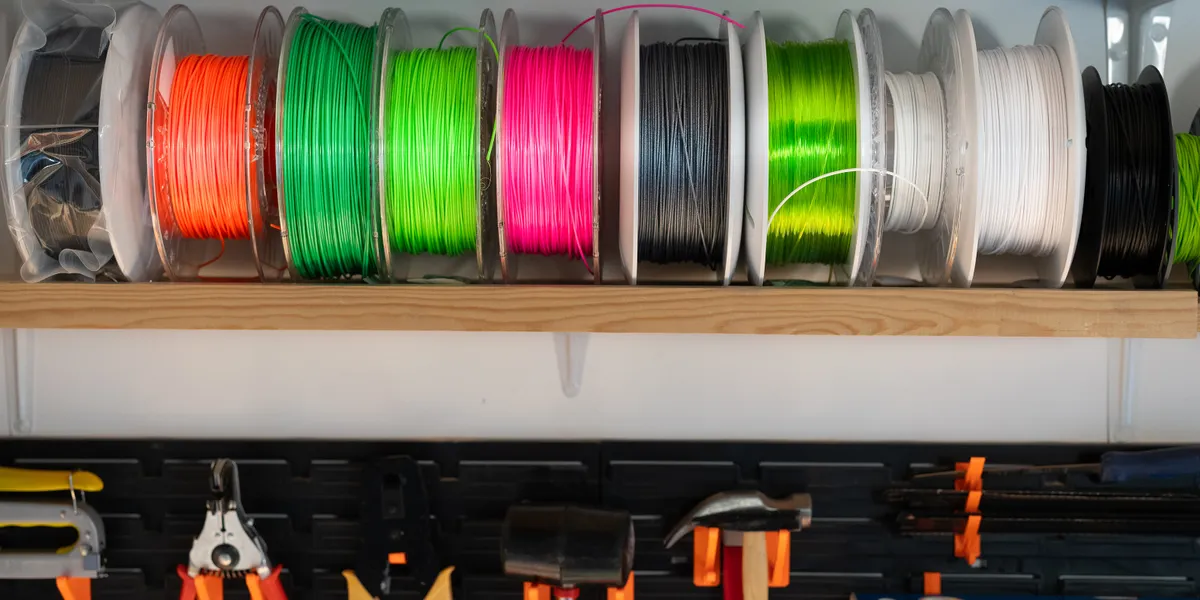
Filament takes on moisture from the air once its bag is open, and a damp spool strings, pops at the nozzle and prints rough, weak layers. Storage is the cheap half of the fix: a sealed box or bag with desiccant keeps a dry spool dry. It cannot rescue a spool that is already damp; that is a dryer's job. These are the storage kits most of the shops we track sell:

Dehumidifying multi-spool filament storage box
Creality

Vacuum-seal bags (with or without an electric pump) that keep opened spools dry between prints
ELEGOO

Vacuum-seal storage for opened filament spools
Creality

Replacement desiccant packs that keep the QIDI Box dry (pack of 4) · QIDI Box
QIDI Tech
Everything for keeping filament printable, dryers included, is on the filament dryers and care shelf.
How to store filament: the three options
| Option | What it does | Best for |
|---|---|---|
| Dry box | A sealed box with desiccant, often with a humidity readout and a port to print from | The spools you print from every week |
| Vacuum bag | A bag you pump the air out of, with desiccant inside | Spare and part-used spools on a shelf |
| Desiccant on its own | Silica gel or similar that soaks up moisture inside a box or bag | Topping up any sealed container |
Prusa's own advice, in its filament drying article, is the same three-part list: keep filament "in a closed space or box, with some desiccant material in it", use a dry box, and use vacuum bags, where "you can use any that will fit a filament inside. Keep a desiccant in the bag when storing the filament."
Which filaments need it most
Not every spool is equally fussy. Prusa says polyamide (nylon), PVA and TPU are "more often in need of drying than more popular filaments like PLA", and that the most moisture-hungry materials (polyamide, polypropylene, PVA, BVOH) should be kept dry or dried before every print. Its example: PLA "doesn't change properties too much by uptaking humidity, whereas Polyamide is affected quite significantly."
So if your storage space is limited, Prusa's advice is to give the sealed space to the most moisture-sensitive materials first. For a terrain printer running mostly PLA, a couple of vacuum bags for the spares is often enough; for TPU or nylon, store every spool sealed.
Dry boxes: print straight from storage
A dry box is a sealed container for one or two spools, with room for desiccant. The better ones add a hygrometer so you can see the humidity inside, and a sealed port so the filament feeds the printer without the lid coming off.
- Prusa USS Drybox: Prusa describes one box per spool, a built-in hygrometer and thermometer, a sealed port for printing from the box, and 10% relative humidity inside when used with 50 g of silica gel (Prusa).
- Polymaker PolyBox Edition II: Polymaker states it holds two 1 kg spools or one 3 kg spool, and says that it does not actively dry: it keeps filament in a dry environment while you print (Polymaker).
Dehumidifying multi-spool filament storage box
Creality
A dry box has no heater. If you want one box that dries a damp spool and then keeps it dry while you print, that is a heated dryer, and our filament dryer guide compares them on each maker's own figures.
Vacuum bags: the cheapest way to store spares
A vacuum bag takes a spool out of the air altogether. Put the spool and a desiccant pack in, pump the air out, and seal it. They are the cheapest storage per spool, and a kit with a pump makes resealing quick enough that you will actually do it.
Vacuum-seal bags (with or without an electric pump) that keep opened spools dry between prints
ELEGOO
Vacuum-seal storage for opened filament spools
Creality
Desiccant: what keeps the air dry
Desiccant does the actual work inside a box or bag, and it gets used up: once it is saturated, it stops absorbing. Replace it, or regenerate it if the maker says it can be dried out. Printers with a sealed multi-spool unit (a Bambu Lab AMS, a QIDI Box) take their own desiccant packs.
Replacement desiccant packs that keep the QIDI Box dry (pack of 4) · QIDI Box
QIDI Tech
A cabinet for a large collection
Once the spools run into double figures, a dehumidifying cabinet holds them all in one place. SUNLU's FilaDC i10 is one, sold by the shops we track outside the UK.

Dehumidifying storage cabinet that keeps many spools dry between prints
SUNLU
Storage is not drying
If a spool already strings or crackles, storing it will not fix it. Dry it first, then store it. Prusa's drying table gives 45 °C for 6 hours for PLA and 55 °C for 6 hours for PETG, and warns not to go hotter "or the filament will soften and stick together." The temperature for every common filament is in our filament dryer guide, and the difference between the two most common materials is in PETG vs PLA.
Questions
What is the best way to store 3D printer filament?
Sealed, with desiccant. A dry box for the spools you print from often, and vacuum bags with a desiccant pack for spares. Prusa recommends the same three options.
Do I need a dry box for PLA?
Less than for other filaments. Prusa says PLA does not change properties much as it takes on moisture, while nylon, PVA and TPU need drying more often. PLA can still absorb enough to cause stringing, so sealed storage helps.
Will a dry box dry out damp filament?
No. A dry box has no heater, so it keeps dry filament dry. A damp spool needs a heated filament dryer first.
Can I use any vacuum bag?
Prusa says you can use any bag that fits the spool, as long as you keep desiccant in it.
We compare what each maker says about its own storage and the prices at the shops we track; we have not used these boxes ourselves.