
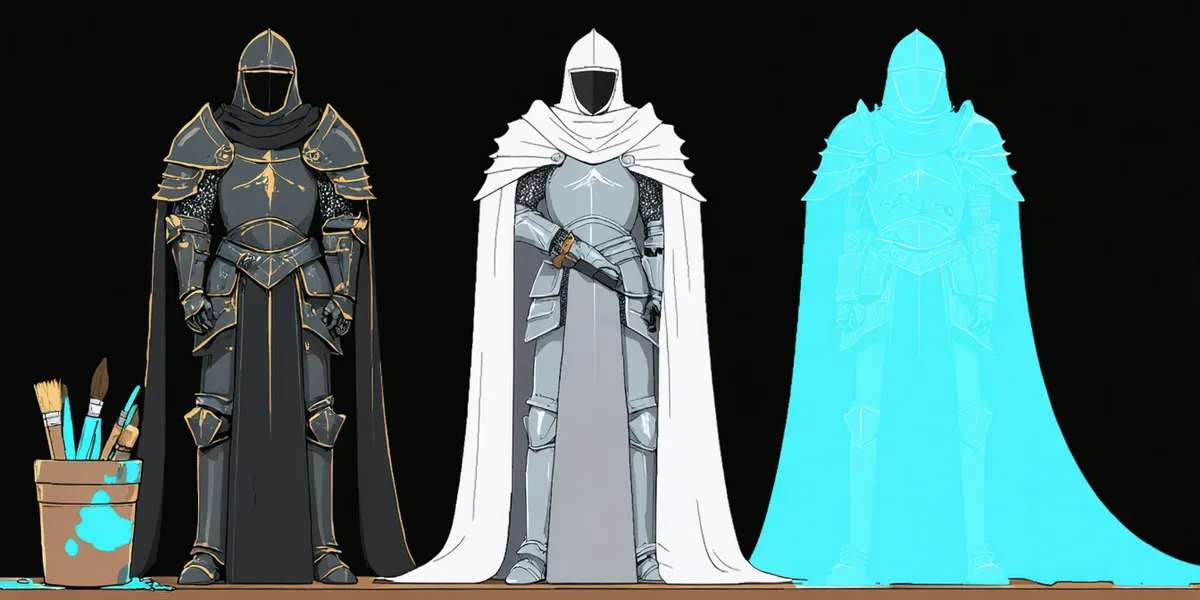
Slapchop - sometimes written slap chop - is the fastest route from grey plastic to a finished-looking army. Build all the lighting in monochrome first with a drybrush, then let a translucent paint - Citadel Contrast, Army Painter Speedpaint, Vallejo Xpress - turn that lighting into colour in one coat. The shading and highlighting are done before any colour touches the model.
What it is, and when to choose it
Every ordinary painting method separates two jobs: put the colour down, then shade and highlight it afterwards with washes, glazes or a brush-controlled gradient. Slapchop reverses the order. You paint the light and shade first, in black, grey and white, using nothing but a drybrush - the underlying skill is ordinary drybrushing, so get comfortable with it first. Then a single coat of translucent paint sits thin over the pale, raised areas and pools thicker in the dark recesses, arriving already shaded and highlighted.
Choose slapchop when you are painting a unit or an army rather than one showpiece model, when the surfaces involved have real texture - cloaks, fur, muscle, rock, ruined stonework - and when "good from three feet away, on the table" is the actual goal. A ten-model squad that would take an evening apiece with wet blending can realistically be done in an evening total.
Choose something else when the model is a display piece, when the armour panels are large and smooth - a drybrush leaves streaks with nothing to catch, so those want an airbrushed zenithal or edge highlighting instead - or when you want the deliberate look of non-metallic-metal or a full wet-blended scheme. It is also not the technique for metal - see metallics, below.
It sits well next to other fast techniques. A quick wash first (see washes and shades) deepens the recesses before the grey drybrush, and a wet palette (see the wet palette guide) keeps a glaze paint workable for longer than the small pot lid does - useful, because reworking a glaze coat is the one thing that ruins it.
What you need
- A black primer. Spray or brush-on, anything matte - see the best spray primers if you need one. This is your darkest shadow and does not get painted over except by the glaze.
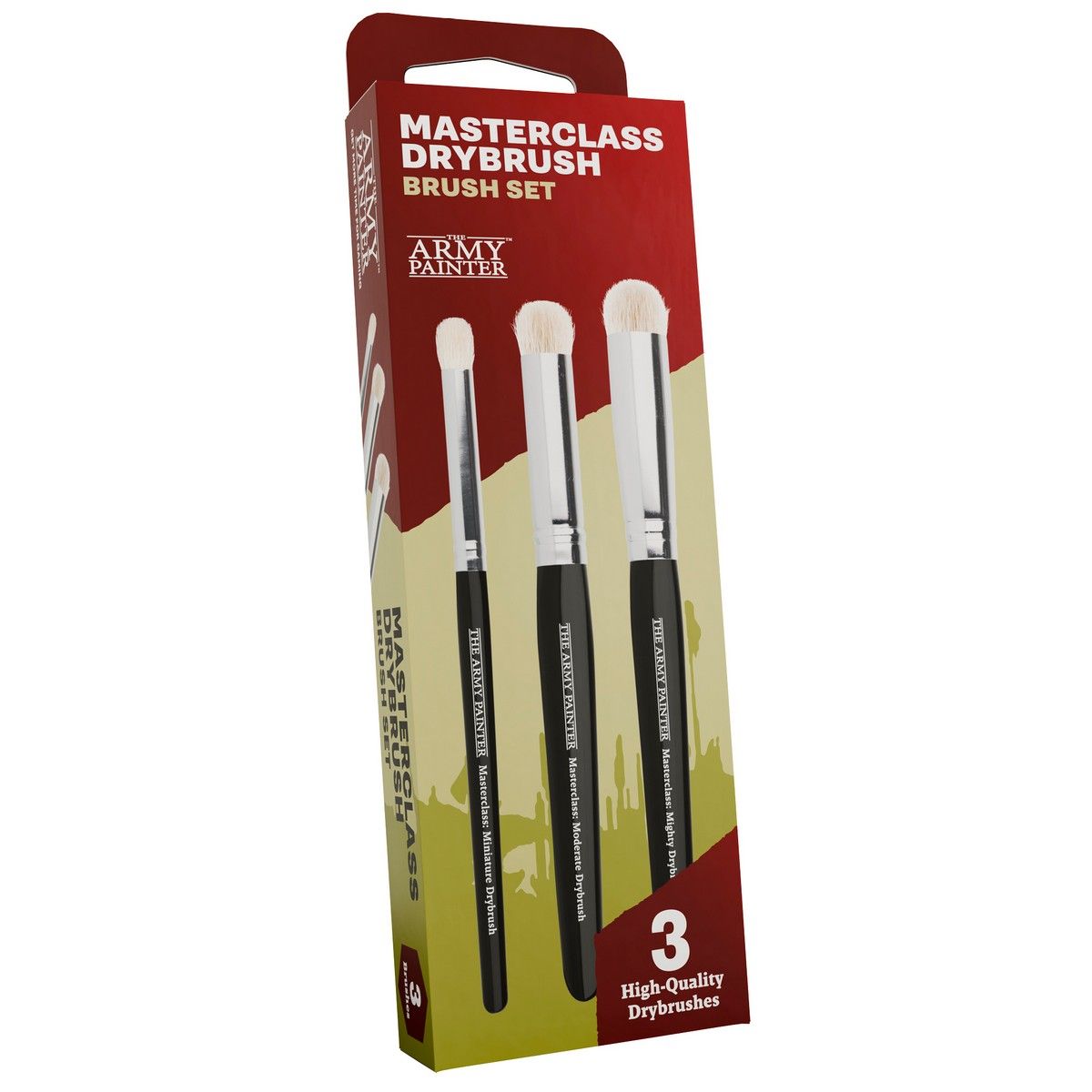
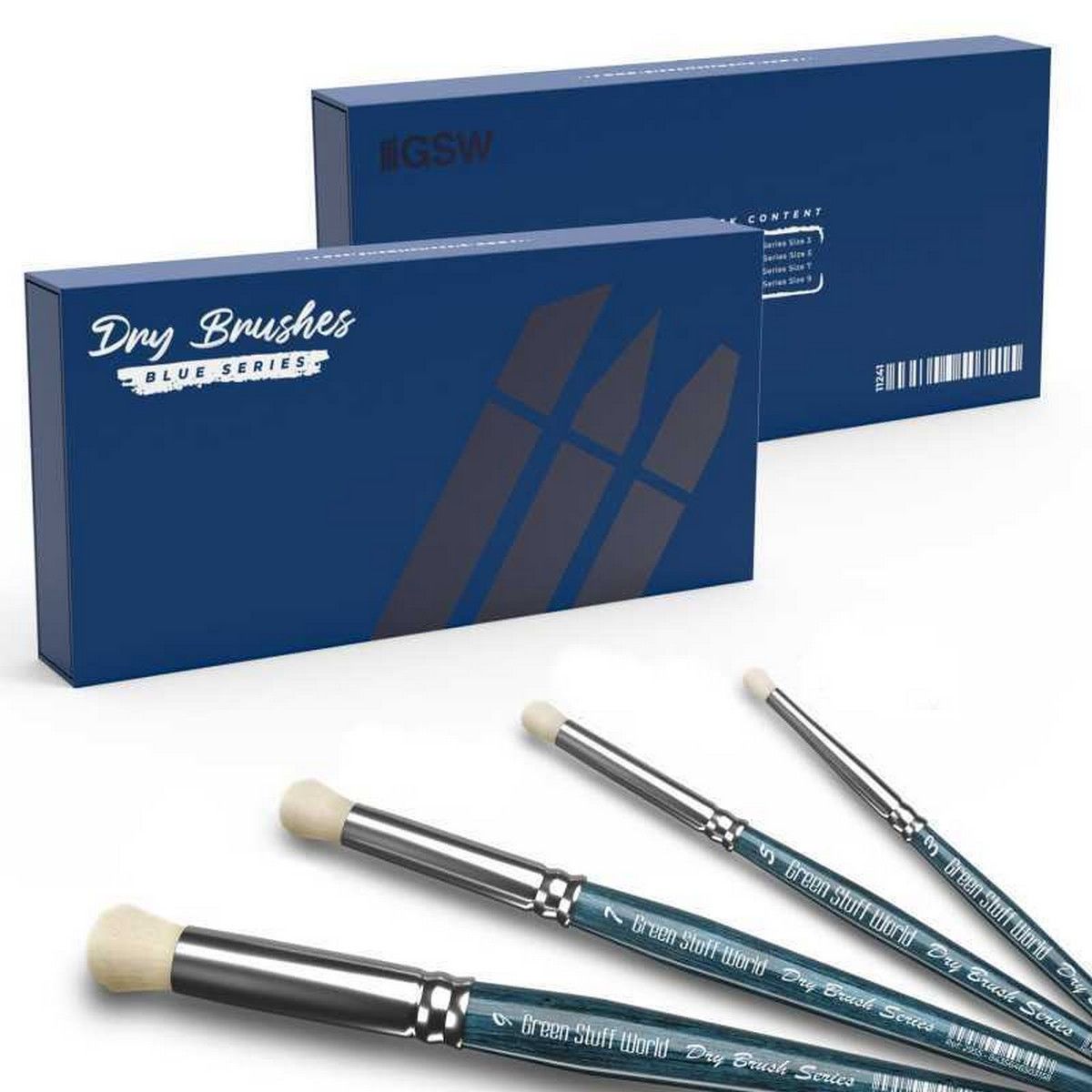
- Two drybrushes, ideally domed rather than flat: something larger and soft for the grey pass, something smaller for the directional white pass. A flat, scrubby brush leaves streaks where a dome lays a smooth gradient - the Artis Opus Series D set popularised the style, and the Army Painter Masterclass drybrush set does the same job for much less.
- A mid grey and a white or off-white paint, for the drybrush stages.
- A translucent one-coat paint in your chosen colour - Citadel Contrast, Army Painter Speedpaint or Vallejo Xpress Color are the three ranges built for this (see the best contrast paints), and they are cross-compatible with each other's underlayers.
- The matching medium, optionally. Each range sells one - Contrast Medium, Speedpaint Medium, Medium Xpress - to extend a glaze over more of the model or soften its pooling without diluting the pigment the way water does.
- A soft, pointed brush for the glaze coat, kept separate from the drybrushes, and normal opaque paint for details afterwards.


synthetic · drybrushing
Monument Hobbies
drybrushing
Green Stuff World
Citadel (Warhammer Paints)
Citadel (Warhammer Paints)
Citadel (Warhammer Paints)
Vallejo
Vallejo
Army Painter
Citadel (Warhammer Paints)
The method, step by step
- Prime black. Any matte black primer, sprayed or brushed. This is your darkest shadow, and it stays visible in every recess once you are done.
- Heavy drybrush a mid grey over the whole model with the larger domed brush, hitting everything except the deepest recesses - between fingers, under overlapping plates, inside folds. Do not be gentle with this pass; it should cover most of the surface.
- Light, directional drybrush of white (or off-white) with the smaller brush, catching only the upper surfaces and edges that would actually face a light from above - the top of the head, shoulders, the crown of raised detail. Less coverage than the grey pass, by a wide margin.
- Check the zenithal sketch before moving on. Held at arm's length, the model should already read as light from above and shadow below, in black, grey and white, with no colour anywhere yet. If it does not, add another light grey or white pass rather than pushing on - the glaze coat cannot fix a flat underlayer.
- Glaze colour over the whole model in one coat, kept thin (see thinning paints). Load the brush properly and lay the translucent paint down in a single, even pass per area - do not go back over a patch once it has started to dry, and do not scrub it in like a normal paint. It settles thin over the pale zenithal areas and pools in the dark recesses, so the coat arrives pre-shaded and pre-highlighted on its own.
- Let it dry fully before touching that area again. A second coat, if the colour needs deepening, goes on only after the first is bone dry - wet-into-wet is what causes tide marks and patchiness.
- Pick out details with normal opaque paint. Metallics, eyes, gems, and any area the glaze has muddied get painted conventionally at the end, over the top.
Practise the glaze pass before a real model
The drybrushing in slapchop is forgiving; the one-coat glaze is not, because reworking it causes the streaks and tide marks that give the technique a bad name.
- Take a spare sprue or an old miniature through steps 1 to 4 above - black prime, grey drybrush, white drybrush.
- Load the glaze paint properly - a full, wet brushload - and lay it down in one pass, moving in one direction.
- Deliberately add a second stroke over the same spot before it has dried, and look at the patchy mark that leaves. That is the mistake to avoid on the real model.
- Reload, try a fresh section, and this time leave it alone the moment it touches the surface. The difference between the two is the whole technique.
Recipes: three armies, three ranges
Each of these pairs a Citadel Contrast paint with its nearest Army Painter Speedpaint and Vallejo Xpress equivalent, glazed straight over the same black-grey-white underlayer above. Painting a scheme none of these three match? The paint matcher finds the nearest glaze across all three ranges.
Blue power armour. Talassar Blue (Citadel Contrast), Beowulf Blue (Army Painter Speedpaint) or Storm Blue (Vallejo Xpress). All three sit on the same grey-to-white zenithal and read naturally dark in the recesses.
Green skin. Ork Flesh (Citadel Contrast), Absolution Green (Army Painter Speedpaint) or Orc Skin (Vallejo Xpress). Good on any greenskin army, and forgiving of the lumpy, muscular texture a drybrush loves.
Bone and undead. Skeleton Horde (Citadel Contrast), Bony Matter (Army Painter Speedpaint) or Bag of Bones (Vallejo Xpress). This leans hardest on the technique's strength - a skeleton is raised ridges and hollows, so the zenithal drybrush does most of the shading before the glaze goes on.
None of the three brands needs the others' medium or thinner - Contrast, Speedpaint and Xpress Color all glaze straight over the same monochrome drybrush, which is the whole point of building the lighting before the colour.
Citadel (Warhammer Paints)
Citadel (Warhammer Paints)
Citadel (Warhammer Paints)
Metallics don't glaze
A translucent glaze reads as colour because light passes through it and bounces back off whatever sits underneath. Metallic paint has no consistent surface to bounce off - it is full of tiny reflective flakes - so a Contrast, Speedpaint or Xpress coat sits on top looking muddy rather than shaded. Drybrush metallic areas the ordinary way instead, in the same light-to-dark stages as drybrushing generally, and paint them as one of the "details afterwards" in step 7 rather than folding them into the glaze pass.
What to know before committing
- Colours come out muted. The grey underlayer dulls the glaze compared with painting over white. Many painters slapchop the model, then re-glaze or edge-highlight the focal areas afterwards.
- It is forgiving, not invisible. Up close you can tell a slapchopped model from a layered one. On the table, at arm's length, across a hundred models - you cannot, and that is the point.
- A wet palette helps more than usual. These paints skin over fast in a normal palette, and a re-wetted, half-dried glaze is exactly what causes streaking. See the wet palette guide.
Common mistakes and fixes
- Reworking the glaze coat. The single most common fault - see the practise drill above. Load properly, lay it down once, and walk away until it is dry.
- An unbalanced zenithal. Too much white flattens the sketch and leaves the glaze nothing to shade against; too little grey (or skipping it) leaves no midtone for the glaze to sit in. Either way the model reads as pure contrast rather than a shaded surface.
- Using a flat, scrubby drybrush. It leaves visible streak marks that show straight through a translucent glaze; a domed brush hides its own strokes.
- Flooding the glaze like a normal paint. A thick, opaque coat just paints over the underlayer. Load the brush properly, but let the paint pool on its own rather than pushing it into the recesses by hand.
- Not sealing the model. These finishes can be more fragile unsealed than a normal acrylic coat. A matte varnish once everything is dry protects it from thumbprints and shelf wear.
Questions people ask
What is slapchop? A fast painting method: drybrush a model's shading and highlights in black, grey and white first, then glaze a single coat of a translucent paint - Citadel Contrast, Army Painter Speedpaint or Vallejo Xpress - over the top. The glaze sits thin on the pale areas and pools in the dark ones, so the coat arrives already shaded.
Can I slapchop with any paint, or only Contrast, Speedpaint and Xpress? Those three ranges are formulated to behave this way - thin and even where the surface is light, pooling where it is dark. A heavily thinned wash can behave similarly, but the purpose-built ranges are the reliable route.
Does slapchop work on smooth armour panels? Not well. A drybrush needs texture to catch, and a smooth panel gives it nothing, so the streaks show straight through the glaze. Use an airbrushed or spray-can zenithal on smooth areas instead, and save the drybrush version for texture-heavy parts of the same model.
How do I fix streaks or a patchy glaze coat? Let it dry completely, then apply a second thin, even coat over the whole area rather than spot-fixing - a partial pass usually makes the patchiness worse. If it is still uneven, a light wash of the same colour over the top will often blend it in.
Do I need to seal a slapchopped model? It is a good habit. These finishes can handle less abrasion unsealed than an ordinary acrylic coat, and a matte varnish once details are finished protects the whole job from handling.
Shop drybrushes
A domed drybrush set is the one purchase slapchop actually requires.
Army Painter Masterclass Drybrush Set
Best price
postage per seller
cheapest of 3 Australian sellers · save A$2.99 vs the most expensive · excl. delivery
We earn a small commission from qualifying purchases at no extra cost to you.