
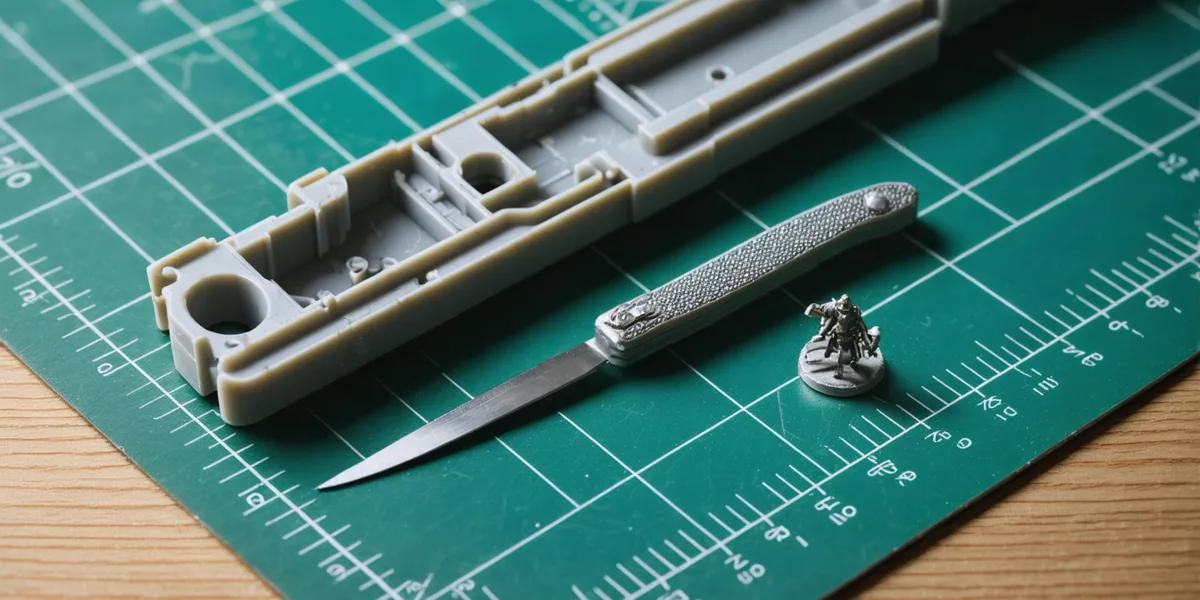
A hobby knife does three jobs on a miniature: it trims the last bit of a sprue gate, it scrapes away mould lines, and it cuts or converts plastic where a part needs reshaping. Almost any sharp, fine-pointed knife can do all three. What makes one better than another is a handle that does not roll off the desk, a blade that is easy and cheap to replace, and a point fine enough to reach into the gap between a hand and a weapon. Here are the knives that are easiest to buy in your market, priced at the shops we track.
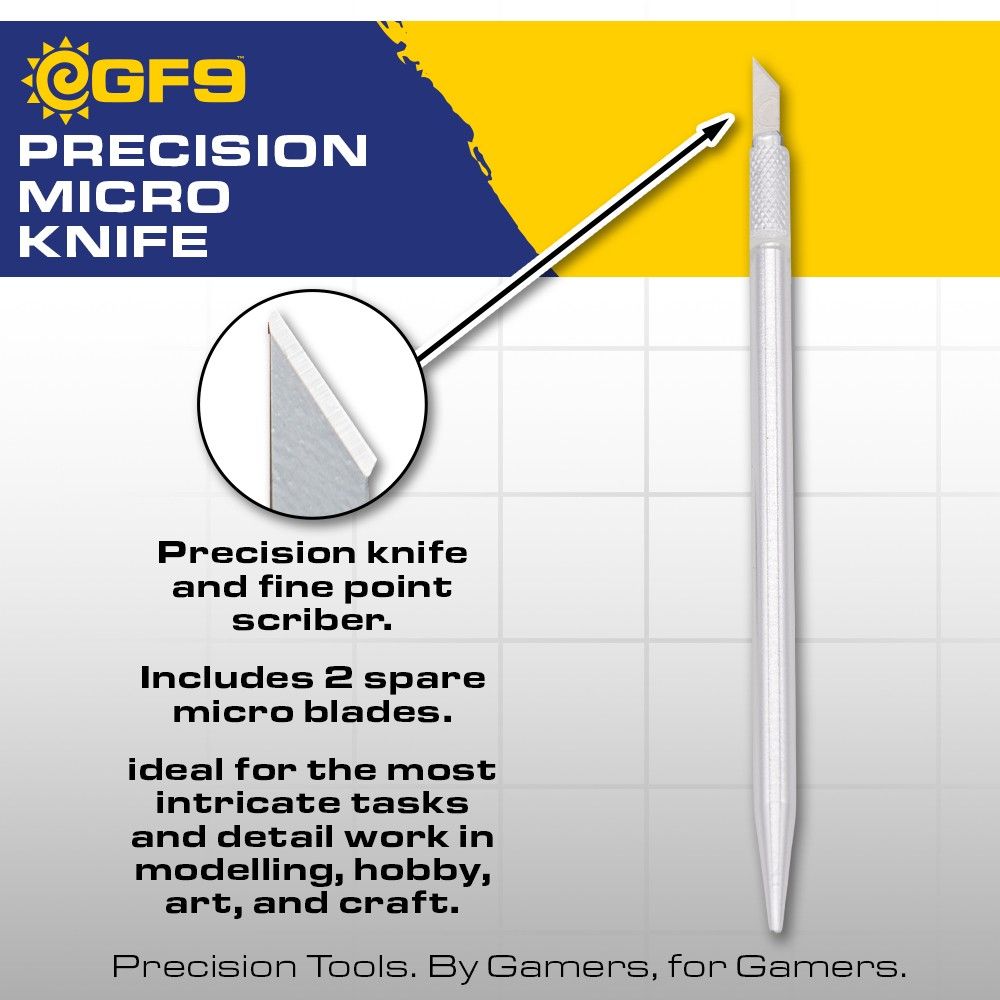
Fine micro knife for detail cutting
Gale Force Nine
Every knife, blade and set below is on our cutting and prep shelf. Descriptions come from each maker's or retailer's own product record. Need a mat as well? See which hobby cutting mat to buy.
Hobby knife or scalpel?
They look similar and do similar work, but they are two different systems, and the blades of one do not fit the other.
A hobby knife (also sold as a craft knife or precision knife) holds its blade in a collet: you twist the handle to loosen it, slide a blade in, and twist to lock. The handle is usually round or faceted and fairly thick. The standard blade is the #11, a long straight fine point, and almost every hobby knife takes it. Excel Blades' K1 and Jakar's screw-collet knife are this kind.
A scalpel has a flat stainless handle with a bayonet fitting; the blade slides onto it and clips in place. Scalpel blades are thin and very sharp, and they are sold cheaply in packs. The catch is that a scalpel blade is easier to snap and harder to change safely. The classic is the Swann Morton No. 3 handle, which takes No. 10, 10A, 11, 12, 15 and 15A blades; the No. 4 handle takes the larger blades from No. 18 up.
For most miniature work, a hobby knife with #11 blades is the easier place to start. Painters who do a lot of fine conversion work, or who scrape every mould line with a blade, often move to a scalpel.
The blades, by number
Two numbering systems are in use, and the same number can mean a different shape in each. These are the ones that matter on miniatures:
- #11 / No. 11, straight fine point. The general-purpose blade in both systems. Trimming gates, cutting plastic, scraping mould lines with the back of the edge.
- #10 / No. 10, curved. A rounded belly for long, controlled cuts and for shaving a flat surface without digging in the point.
- No. 12, hooked. A concave scalpel blade with the edge on the inside of the curve, for undercuts and for scraping inside curves.
- #17, chisel. A flat chisel end for shaving off a moulded detail or levelling a surface, as when removing a badge for a conversion.
Blades go dull faster than you expect, and a dull blade is the one that slips. Buy them in packs and change them often: Excel's #11 blades come in a hundred-blade pack, Swann Morton's No. 11 and No. 10 in fives, and AK sell straight No. 11, curved No. 10 and concave No. 12 scalpel blades in tens. For the Vallejo No. 1 handle there are packs of No. 11 fine point, No. 10 curved and No. 17 chisel blades.
The best hobby knife for most painters
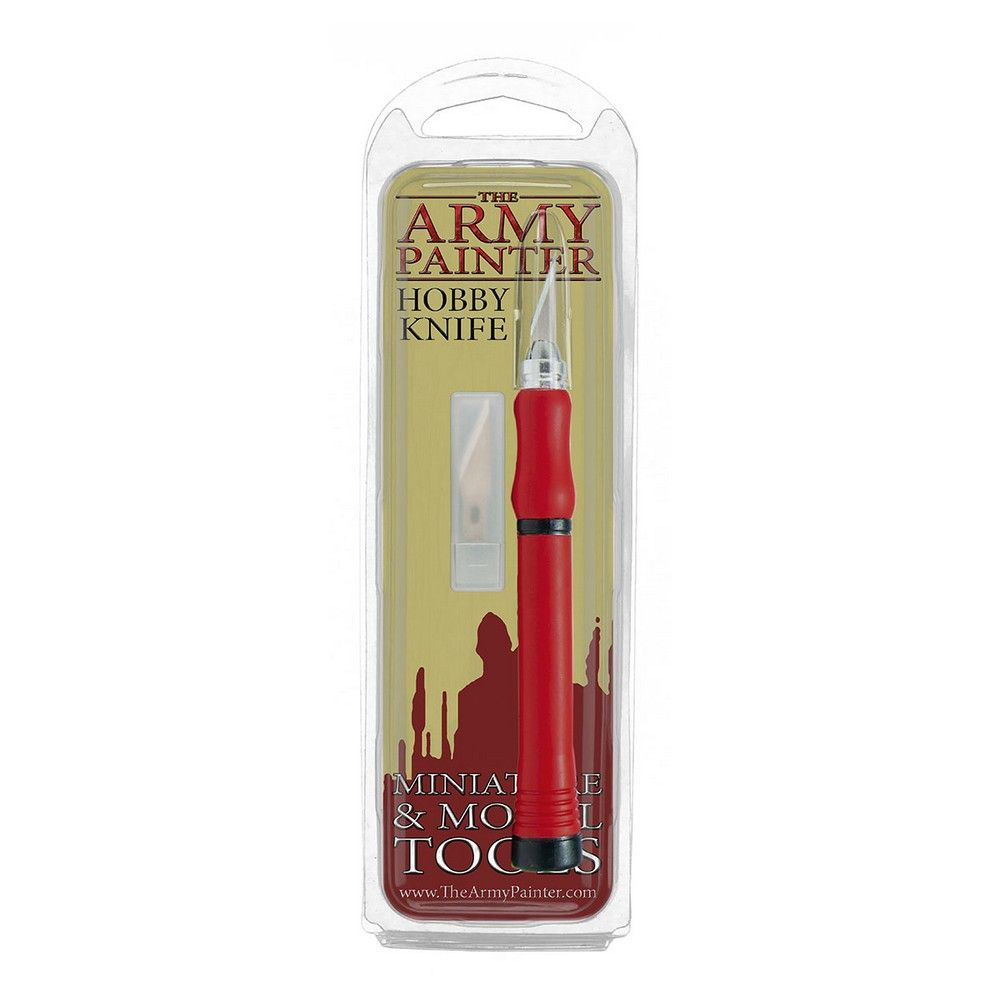
- Army Painter Hobby Knife: a hobby knife with a moulded grip, and the most widely stocked knife on our shelf. Sold in all five of our markets.
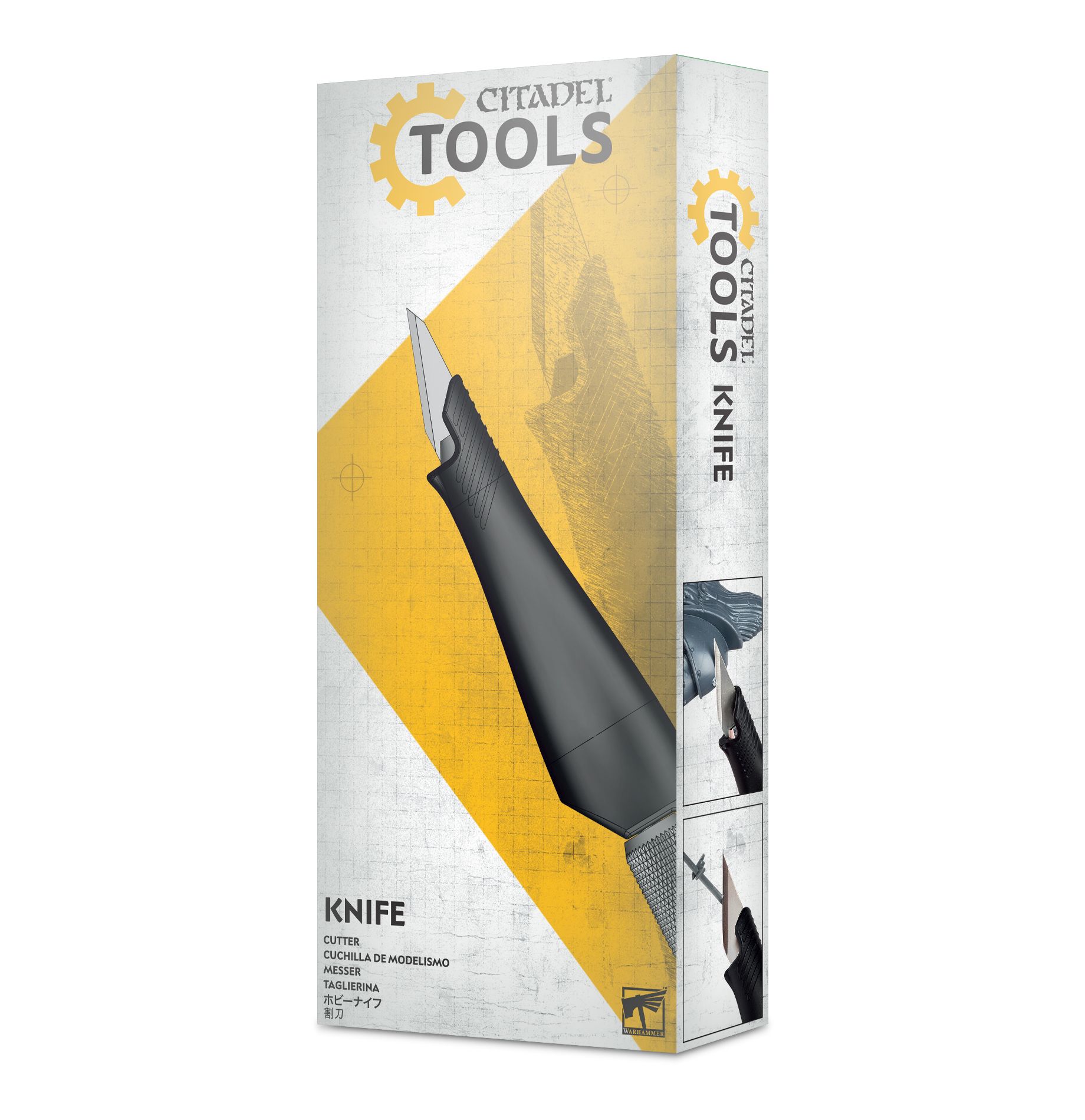
- Citadel Tools: Knife: Games Workshop's own hobby knife, also sold in all five markets.
- Gale Force Nine Precision Micro Knife: a fine micro knife for detail cutting.
- AK Interactive Hobby Knife: a scalpel-style hobby knife.
- Excel Blades K1 Craft Knife: a light-duty knife for #11 blades, here with five spares. Excel also make the K18 knife with fifteen #11 blades in a dispenser.
- Vallejo Tools Classic Craft Knife No. 1 and the soft-grip version: a No. 1 handle supplied with a No. 11 blade.
Fine micro knife for detail cutting
Gale Force Nine
The best scalpel for miniatures
The Swann Morton No. 3 Scalpel Handle is the one to buy: stainless steel, and it takes the No. 10, 11 and 12 blades that cover nearly all miniature work. The AK Interactive Standard Scalpel Handle is supplied with a No. 11 blade, and Green Stuff World's Craft Knife with Spare Blades is an all-metal scalpel handle with ten #11 blades. If you only ever want to change a blade with your fingers well away from the edge, Swann Morton's Trimaway Knife is a disposable knife with a fixed blade and a guard.
Hobby knife sets
A set makes sense if you also need a cutting mat, or if you want several blade shapes to find out which you use.
- Jakar A5 Cutting Mat with Hobby Knife and 5 Blades: a self-healing A5 mat, a hobby knife and a pack of spare blades. A good first purchase, since a mat protects the desk and the blade.
- Jakar Hobby Knife with 6 Assorted Blades: a screw-collet knife supplied with six different blade shapes.
- Excel Blades Basic Craft Knife Set: a K1 and a K2 handle with assorted blades, and the larger Precision Craft Knife Set.
- Excel Blades Precision Cutting Kit: a craft knife with a cutting mat.
- Clarke CHT404 52-Piece Craft Knife Set: a large craft knife set.
Which hobby cutting mat: A3, A4 or A5
A self-healing cutting mat is layered PVC that closes up behind a blade, so the knife cuts cleanly and the next cut does not catch in the last one. It protects the desk, stops the blade skating on a hard surface, and keeps the tip sharp for longer. For miniatures, three things matter: the size, the grid, and whether it heals.
Size. An A3 cutting mat is the usual hobby desk size: room for a sprue, the knife and the part you are working on, and still small enough to leave out. Most mats sold as A3 are about 450 x 300mm, a little larger than the paper size, so the whole A3 sheet fits inside the border; Warlord's and DSPIAE's give that figure. An A4 mat (about 300 x 220mm) suits a small desk or a painting station where the mat shares space with a palette. A5 is a travel size for a club bag. Go to A2 or larger only if you build terrain or cut foam board.
Grid. A printed grid squares up a cut, and it measures a conversion or a movement tray at a glance. Jakar's mats print metric on one side and imperial on the other; Green Stuff World's Scale Cutting Mats print scale rules on the surface.
Colour. A dark mat shows pale plastic parts and a small cut piece better than a green one, which is why black mats are popular for miniatures. It is a preference, not a spec.

Self-healing cutting mat, A3, 450 x 300 mm · AT-CA3
DSPIAE
The Redgrass Games Painting Mat A3 is described by the maker as cut-resistant rather than self-healing: it is a desk mat for painting that also takes a knife, so it suits a painting desk better than a heavy cutting bench.
The smaller mats, A4 and A5, and the ones sold in most of our markets:
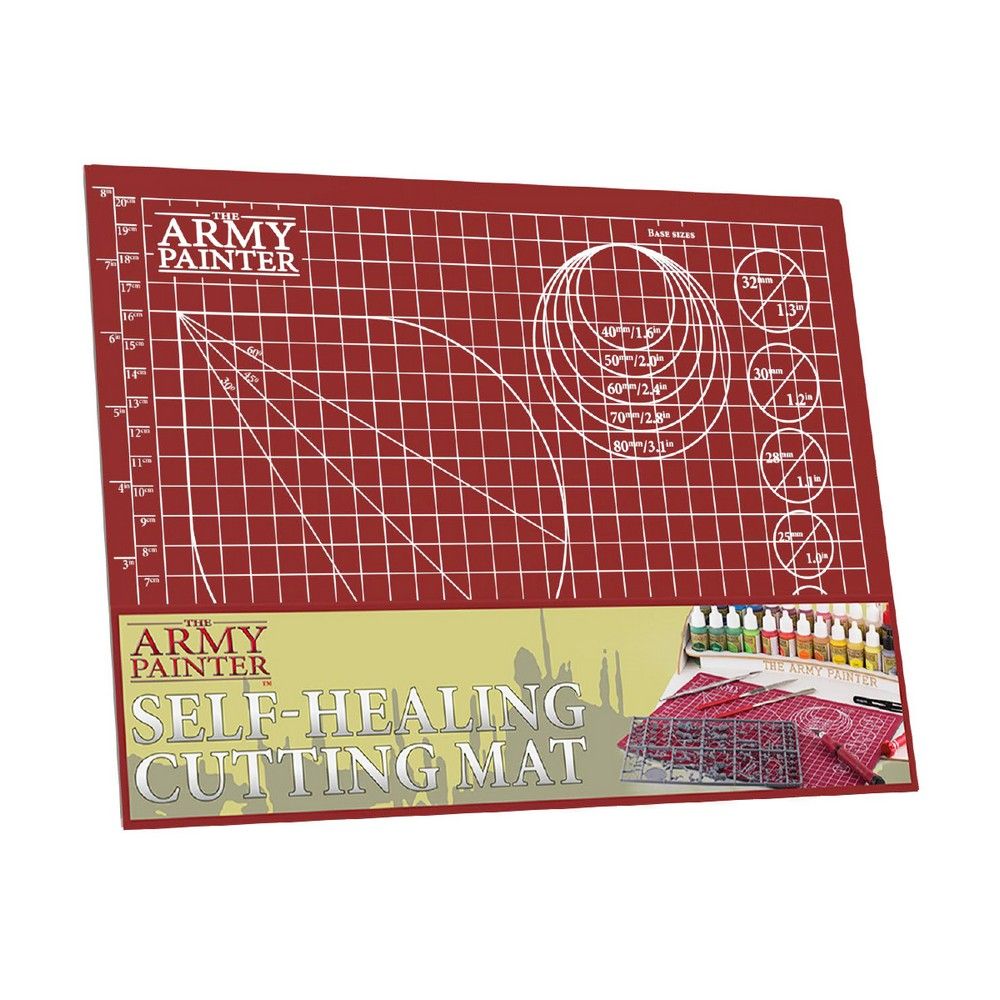
Self-healing cutting mat
Army Painter

Self-healing cutting mat, A4, 300 x 220 mm · AT-CA4
DSPIAE
For terrain and big builds, a mat of A2 or larger saves moving the work.
DSPIAE's A2 mat is 600 x 450mm. A glass mat is the exception to "self-healing": GodHand's Glass Cutter Mat is tempered glass with a 1cm grid, made for cutting masking tape, decals and thin sheet, where a flat, hard surface gives a cleaner edge. It dulls a blade faster, so it sits beside a PVC mat rather than replacing it.

Self-healing cutting mat, A2, 600 x 450 mm · AT-CA2
DSPIAE

Tempered glass cutting mat with a 1 cm grid, for masking tape, decals and thin sheet · 151 x 227 mm · 4562349877164
GodHand
Looking after a mat: keep it flat and out of direct sun or heat, which warps PVC; cut with light passes, since a heavy cut scores deeper than the mat can heal; and use the whole surface rather than the same spot every time.
Cutting safely
Most knife accidents at the hobby desk come from the same few habits.
- Cut away from yourself, and away from the hand holding the part. If the cut has to come towards you, turn the part.
- Keep the holding hand behind the blade, never in its path.
- Use a cutting mat. It stops the blade skating on a hard desk. The mat section above covers which size.
- Change the blade when it starts to drag. A dull blade needs more force, and more force is what makes it slip.
- Take several light passes rather than one hard one when cutting through plastic.
- Put old blades in a sealed container (an empty blade case or a jar) rather than the bin.
Knife or nippers?
Use clippers to take parts off the sprue and the knife to clean up what is left. Cutting parts off the frame with a knife alone is slower, puts sideways pressure on thin parts, and is how most knife slips happen. The sprue cutter guide covers which clippers to buy and how to remove a mould line. Once the parts are clean, plastic glue for miniatures covers what to join them with.
Tips
- One knife, a pack of #11 blades and a cutting mat cover almost everything you need to build miniatures.
- Scrape mould lines with the back of the blade, dragging it along the seam, so the edge does not dig in.
- Change blades often. They are the cheapest part of the hobby.
- Match the blade to the handle. Scalpel blades and hobby knife blades are not interchangeable.
- Keep the knife capped or stood upright when you put it down, so you never pick it up by the blade. A tool stand gives it a home; see hobby desk organiser ideas.
Questions
What is the best knife for miniatures?
A hobby knife that takes
What size cutting mat do I need for miniatures?
An A3 mat, usually about 450 x 300mm, suits most hobby desks. Choose A4 for a small desk or a shared painting station, A5 for travel, and A2 or larger for terrain.
Is a self-healing cutting mat worth it?
Yes. It closes up behind the blade, so cuts stay clean, the desk is protected and the knife stays sharp for longer.
Scalpel or hobby knife for miniatures?
A hobby knife is easier to start with and its blades are easier to change safely. A scalpel blade is thinner and sharper, which painters doing fine conversion work often prefer.
Compare hobby knives
Every knife, scalpel and blade pack we track, priced side by side at the shops that list it in your market.
We earn a small commission from qualifying purchases at no extra cost to you.