
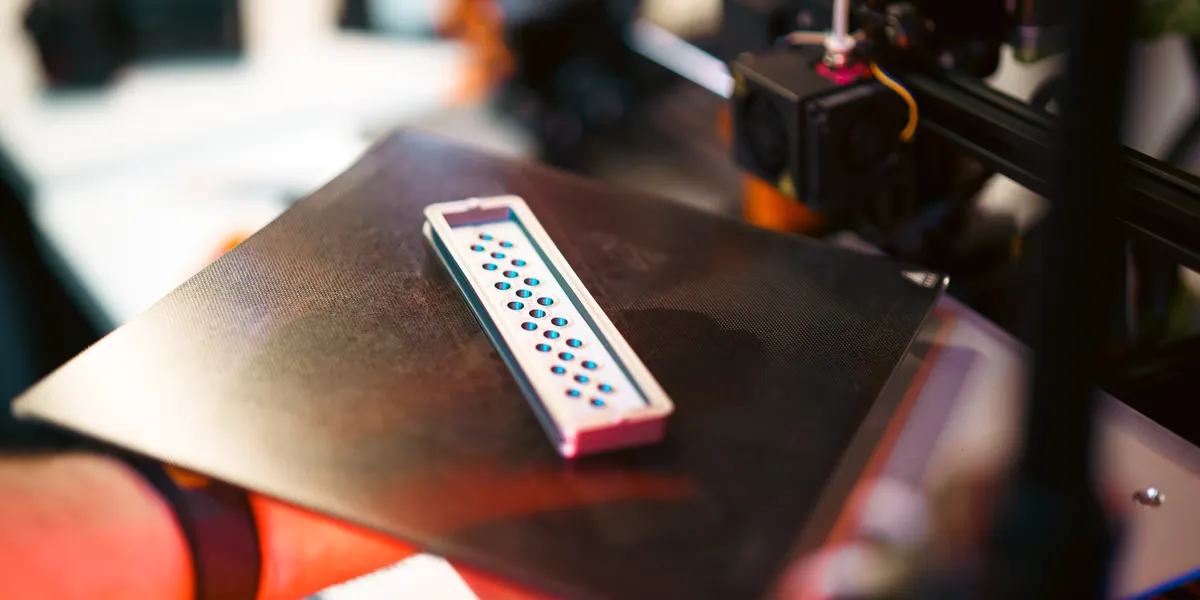
A textured PEI plate is the safest all-rounder: PETG and TPU release from it without damage, and prints pop off once it cools. A smooth PEI plate gives a glossy underside and grips PLA well, but PETG and TPU can stick to it so hard they damage the sheet. Build plates are sized to one printer, so match the model name first. These plates are sold by the shops we track in the most markets:

Double-sided gold textured PEI spring-steel build plate · X-Max 3
QIDI Tech

Dual-sided textured PEI build plate · Plus5
QIDI Tech

Double-sided smooth PEI build plate · Plus4
QIDI Tech

Smooth PEI spring-steel build plate · K1 Max
Creality

Spare dual-sided PEI spring-steel build plate for the Neptune 4 and 4 Pro · Fits Neptune 4, Neptune 4 Pro
ELEGOO
Every plate we track is on the FDM build plates shelf, filterable by surface and by the printer it fits.
Textured vs smooth PEI at a glance
| Textured PEI | Smooth PEI | |
|---|---|---|
| Surface | A powder-coated PEI layer on spring steel | A PEI sticker on spring steel |
| Underside of the print | Textured finish | Smooth, glossy finish |
| PLA | Prusa says small PLA prints may need a brim | Prusa: "ideal for printing PLA" |
| PETG | Prusa: "ideal for extensive printing of PETG" | Can bond too hard; Prusa advises a thin glue stick layer |
| TPU | Prusa: ideal, and no glue stick needed | Can bond too hard and damage the sheet |
| ABS, ASA, nylon, PC | Prusa: needs glue stick as a separation layer (ASA, ABS, nylon, PC Blend) | Prusa: may need glue stick (ASA, ABS, PC Blend) |
| Cleaning | IPA when cold; never acetone | IPA when cold; acetone occasionally |
All from Prusa's own pages for its textured and smooth sheets. Other makers' plates use the same two surfaces; follow their care notes where they differ.
Smooth PEI: a glossy base for PLA
Prusa describes its smooth sheet as "ideal for printing PLA, HIPS, ABS/ASA, composite materials (metal/wood)" and "compatible with most types of filament". The underside of the print comes off flat and shiny, which suits a terrain tile or a display base whose bottom shows.
Its weakness is the filaments that grip too well. Prusa warns that "some filaments, like TPU and PETG, will adhere too much and can damage the sheet when removed", and that PETG, ASA, ABS and PC Blend "may need a protective separation layer, like gluestick, applied thinly before printing". Prusa's PETG page goes further: "Do not print on the smooth PEI sheet as the adhesion may be too strong!" Choosing between the two filaments in the first place? See PETG vs PLA.
Double-sided smooth PEI build plate · Plus4
QIDI Tech
Smooth PEI spring-steel build plate · K1 Max
Creality

Smooth PEI build surface for a glossy first layer · Q2
QIDI Tech

Smooth PEI build plate · Q1 Pro
QIDI Tech
Textured PEI: the all-rounder for PETG and TPU
Prusa's textured sheet is powder-coated with PEI and "ideal for extensive printing of PETG, CPE, TPEE/TPU", with "no need for glue-stick with flexible filaments". It also says "prints automatically detach after the sheet cools down". The bottom of each print carries the texture, which most terrain hides anyway.
Prusa lists a few cautions: ASA, ABS, nylon and PC Blend need glue stick as a separation layer, small PLA prints may need a brim, and the coating is "not scratch-resistant", so use a plastic scraper.
Double-sided gold textured PEI spring-steel build plate · X-Max 3
QIDI Tech
Dual-sided textured PEI build plate · Plus5
QIDI Tech
Dual-sided plates
Some plates carry a different surface on each side, so you flip the sheet to suit the filament. ELEGOO's dual-sided plates for the Neptune 4 and Centauri, and Bambu Lab's Dual Texture plate, are examples. Check the product listing for which surfaces it carries.
Spare dual-sided PEI spring-steel build plate for the Neptune 4 and 4 Pro · Fits Neptune 4, Neptune 4 Pro
ELEGOO

Spare dual-sided PEI build plate, the original surface the Centauri ships with · Fits Centauri series
ELEGOO
Double-sided smooth PEI build plate · Plus4
QIDI Tech
Cool plates for PLA
A third kind of plate, sold as a cool or cold plate, is made for printing PLA at a low bed temperature. Bambu Lab's Cool Plate SuperTack and ELEGOO's Cold Plates are examples, and they are on the build plates shelf.
Cleaning a PEI plate
Prusa says grease greatly reduces adhesion, so keep fingers off the print area. Its instruction for both sheets is to clean them with "~90% IPA or denatured alcohol" when cold, and not to use anything made for skin. Acetone is allowed on the smooth sheet occasionally (Prusa says 1 to 2 times a month), but "never clean the sheet with acetone" on the textured one, because it damages the surface.
Match the plate to your printer
A build plate is sized to one printer bed, and many are magnetic sheets that sit on that printer's own base. That is why ELEGOO sells separate plates for the Neptune 4 Pro, 4 Plus and 4 Max. On the build plates shelf, the "fits my printer" filter shows only the plates for your machine.
Questions
Is textured or smooth PEI better?
Textured is the safer all-rounder, because PETG and TPU release from it without damage. Smooth gives a glossier underside and grips PLA well, but PETG and TPU can bond to it too hard.
Can I print PETG on smooth PEI?
Prusa advises against it, or a thin layer of glue stick as a separation layer first, because PETG can stick too well and damage the sheet.
How do I clean a PEI build plate?
Prusa says to use about 90% isopropyl alcohol or denatured alcohol on a cold sheet. Never use acetone on a textured sheet.
Do build plates fit any printer?
No. Each plate is sized for one printer bed, so match the model name on the listing to your printer.
We compare what the makers publish and the prices at the shops we track; we have not printed on these plates ourselves.