
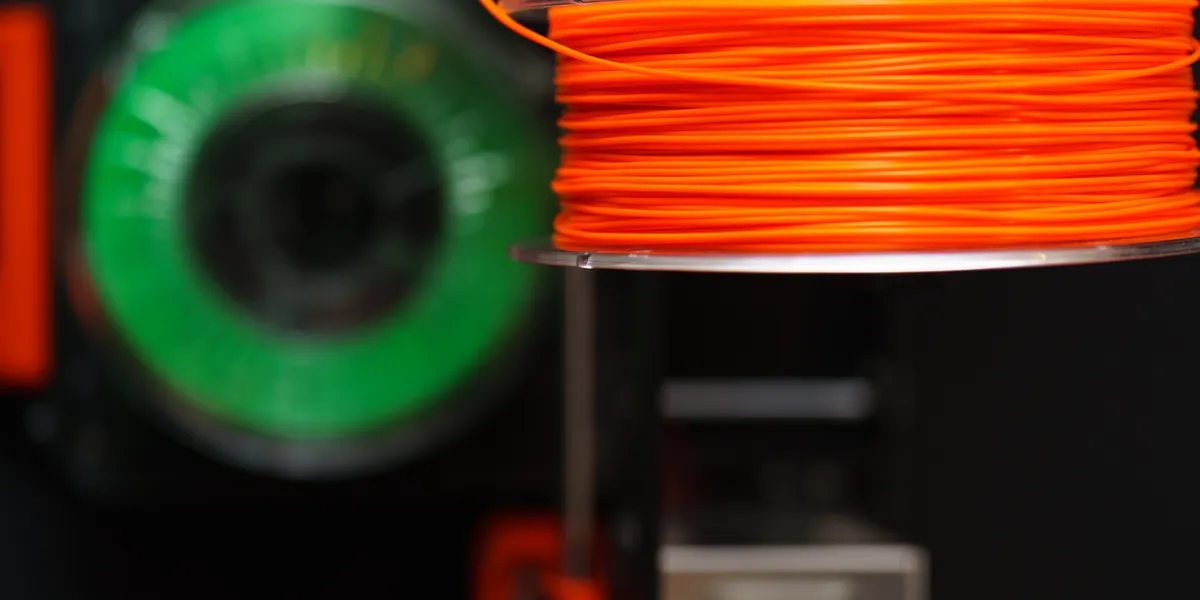
For most terrain, scatter and bases, print in PLA. It is the easiest filament to print, holds crisp detail and paints like a plastic kit. Switch to PETG for pieces that get handled, dropped, packed into a case or left somewhere warm, because it is tougher and copes with more heat. These are 1 kg spools of each that several of the shops we track sell:

Tougher, less brittle PLA+ filament · 1kg
ELEGOO

Standard PLA filament: the easiest material for terrain, props and display pieces · 1kg
SUNLU

PLA filament: the easy all-rounder for terrain, bases and display prints · 1kg, 1.75 mm
Creality

PETG filament: tougher and more heat-tolerant than PLA, easy to print · 1kg
ELEGOO

PETG filament: tougher and more heat-tolerant than PLA, easy to print · 1kg
SUNLU

PETG / co-polyester filament: tougher and more heat-resistant than PLA, still easy to print · 1kg, 1.75 mm
Creality
Every spool we compare is on the PLA filament and PETG filament shelves, priced per kilo in your currency. Settings for sixteen filaments, these two included, are in our filament temperature chart.
PLA vs PETG at a glance
| PLA | PETG | |
|---|---|---|
| Nozzle temperature (Prusa's settings) | 215 °C first layer, 210 °C after | 230 °C first layer, 240 °C after |
| Bed temperature (Prusa's settings) | 60 °C | 85 °C first layer, 90 °C after |
| Ease of printing | Prusa calls it "one of the easiest materials to print" | Strings more; Prusa tunes it with retraction and cooling |
| Strength | Stiff but brittle: Prusa says it "breaks along layers or into shards upon impact" | Tougher: Prusa recommends it for mechanical parts |
| Heat | Prusa: "it gets soft and deforms at temperatures over 60 °C" | Prusa: good temperature resistance, fit for interior and most exterior use |
| Build plate | Sticks well to smooth PEI | Can bond too hard to smooth PEI: use textured, or glue stick as a release layer |
| Drying (Prusa's table) | 45 °C for 6 hours | 55 °C for 6 hours |
| Best for | Most terrain, scatter, bases and display pieces | Club terrain, case inserts, racks and anything handled often |
The temperatures are Prusa's for its own Prusament filaments, from its PLA and PETG material pages and its filament drying table. Other brands print in the same ranges, but the label on your spool is the setting to start from.
Why PLA is the default for terrain
PLA prints at the lowest temperatures of the common filaments, barely warps, and does not need an enclosed printer. For a ruined building, a stack of crates or a sheet of bases, that means fewer failed prints and less tuning. It can be sanded too, wet: Prusa says PLA sanding needs water cooling, so a layer line on a flat wall can be knocked back before priming.
The catch is that it is brittle. A thin PLA spire or railing snaps rather than bends, and Prusa says it softens above 60 °C, so a PLA print left in a car on a hot day can sag. Prusa itself places PLA as the filament for concept models, prototypes and "low-wear toys", which is a fair description of most scenery.
PLA comes in several finishes. Matte PLA hides layer lines better under a thin coat of paint, and PLA+ or PLA Pro lines are made tougher than plain PLA. Silk and specialty PLAs (marble, wood-fill, glow) are for display pieces you may leave unpainted. All of them are filters on the PLA shelf.

Matte PLA filament that hides layer lines · 1kg
ELEGOO

Tougher, less brittle PLA filament · 1kg
ELEGOO

PLA Meta filament in soft macaron colours · 1kg
SUNLU

Matte PLA filament tuned for high-speed printers; hides layer lines · 1kg
QIDI Tech
When PETG is worth it
PETG is the filament for pieces that have to survive. Prusa describes it as "especially suitable for mechanical parts for both indoor and outdoor use", and lists holders, clamps and waterproof parts among its uses. For a wargamer that means club terrain that travels every week, foam-tray replacements and carry-case inserts, paint racks, and storage that sits on a sunny windowsill.
It asks more of you. It prints hotter, on a hotter bed, and strings more easily; Prusa's fix is more retraction, a lower nozzle temperature within the range, and part cooling. On a smooth PEI plate it can stick so well that it damages the sheet when you remove it, so Prusa says to print it on a textured sheet or put a thin layer of glue stick down first. Our textured vs smooth PEI guide covers which plate to use.

PETG filament tuned for high-speed printers · 1kg
ELEGOO

High-flow PETG filament for fast printers: tougher and more heat-tolerant than PLA · 1kg
ELEGOO

Translucent PETG filament · 1kg
QIDI Tech
Painting PLA and PETG
Both take acrylic paint once primed. PLA primes like any plastic kit, with the same spray or brush-on primer you use on miniatures. PETG has a glossier surface, so give it a primer made for plastics and let it cure fully before you handle it. Our spray primer guide compares the cans.
What about ABS and ASA?
ABS and ASA are tougher and more heat-resistant again, but they need an enclosed printer. Bambu Lab's own comparison of its two P1 printers rates ABS and ASA as "Ideal" on the enclosed P1S and only "Capable" on the open P1P (Bambu Lab P1S page). For terrain and scenery, PLA and PETG cover almost every job without that extra step. Our PLA vs ABS, PETG vs ABS and ASA vs ABS guides compare them in full, and PLA vs PLA+ covers the tougher PLAs, and Silk PLA vs PLA the shiny one for display pieces. For every material side by side, with the spools to buy for each job, see the best filament for terrain and miniatures.
Can you print miniatures in PLA?
You can print 28 mm miniatures on a filament printer, but the detail on faces and hands is softer than a resin print, and supports leave more marks. Most people print terrain, vehicles and bases in PLA and leave infantry to a resin printer. Our resin vs FDM guide explains the trade-off.
Keep it dry
Both filaments pick up moisture once the bag is open, and a damp spool strings and prints rough walls. A sealed box with desiccant keeps a dry spool dry, and a dryer rescues a damp one: see our filament storage guide and our filament dryer guide.
Questions
Is PETG stronger than PLA?
PETG is tougher. It flexes before it breaks, where PLA is stiff and snaps. Prusa describes PLA as brittle and PETG as suitable for mechanical parts.
Which is better for wargaming terrain, PLA or PETG?
PLA for most terrain, because it is the easiest to print and keeps sharp detail. PETG for pieces that are handled, transported or kept somewhere warm.
Do I need a different printer for PETG?
No. Any printer that reaches the temperatures on the spool will print it; Prusa's settings are 230 to 240 °C at the nozzle and 85 to 90 °C on the bed. An enclosure is not needed, as it is for ABS and ASA.
Can I print PETG on a smooth PEI plate?
Prusa warns that PETG can stick too well to smooth PEI and damage the sheet. Use a textured sheet, or a thin layer of glue stick as a release layer.
We compare the makers' published settings and the prices at the shops we track; we have not printed with these spools ourselves.