
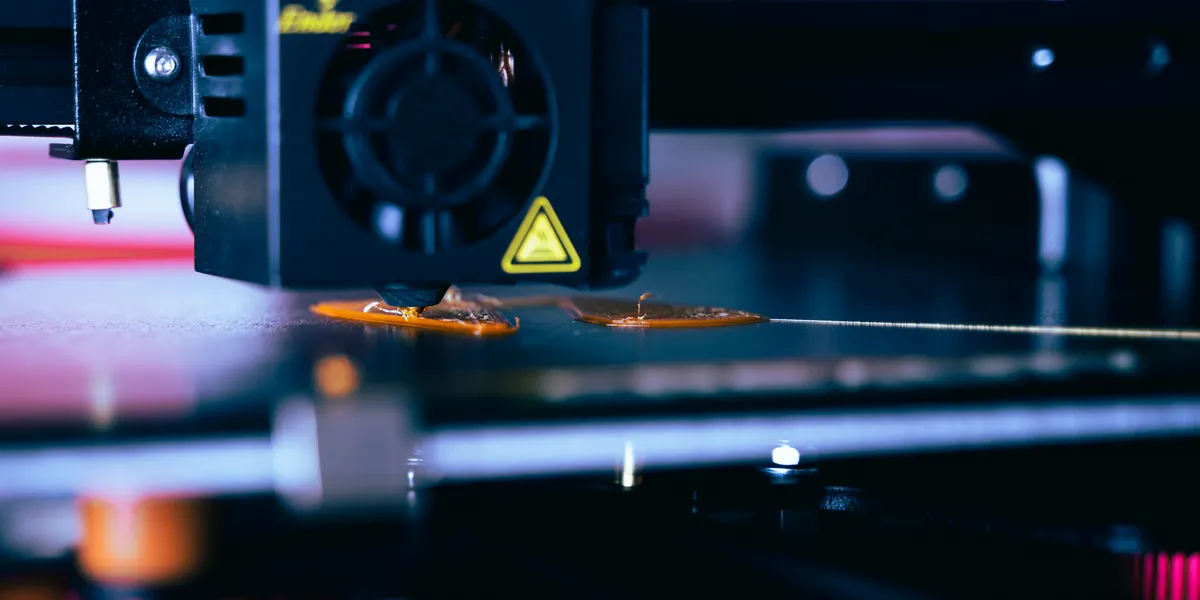
Almost every filament printer ships with a 0.4 mm nozzle, and for most terrain that is the right one to keep. A 0.2 mm nozzle prints finer detail more slowly; a 0.6 mm or larger nozzle prints big pieces faster with less fine detail; and a hardened steel (or other abrasion-resistant) nozzle is only needed for abrasive filaments such as carbon-fibre blends. Nozzles fit one printer family, so match the model name. These nozzle kits and sets are sold by the shops we track in the most markets:

Brass nozzles in several sizes for the Neptune 4 series (Type-C toolhead) · Fits Neptune 4, 4 Pro (Type-C), 4 Plus, 4 Max
ELEGOO

Nozzles in several sizes, brass and hardened steel, for the Centauri printers · Fits Centauri series
ELEGOO
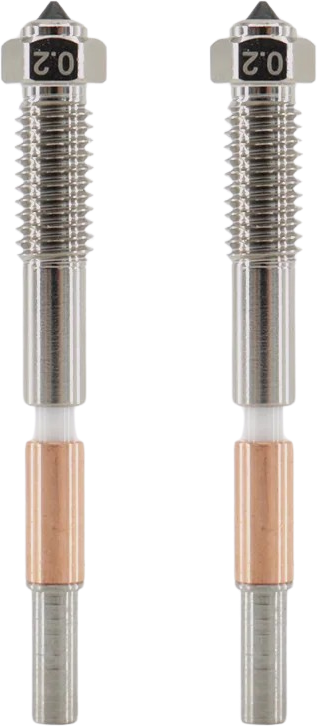
Replacement bimetal FDM nozzle set for Q2 · 2 x 0.2 mm · Q2
QIDI Tech
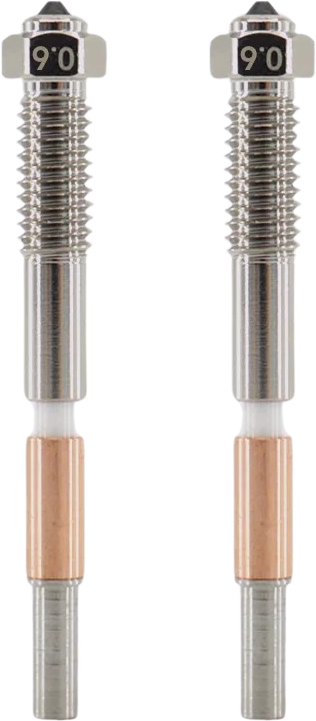
Replacement bimetal FDM nozzle set for Q2 · 2 x 0.6 mm · Q2
QIDI Tech

Replacement FDM nozzle set for Creality K1C, Ender 3 V3, Ender 3 V3 Plus (per 3DJake) · 2 x 0.4, 1 x 0.6, 1 x 0.8 mm (per 3DJake page) · Creality K1C, Ender 3 V3, Ender 3 V3 Plus (per 3DJake)
Creality

Hardened-steel nozzles for abrasive filament on the Neptune 4 series (Type-C toolhead) · Fits Neptune 4, 4 Pro (Type-C), 4 Plus, 4 Max
ELEGOO
Every nozzle we track is on the nozzles and hotends shelf, where you can filter by size and by the printer it fits.
3D printer nozzle sizes compared
| Nozzle | Good for | Trade-off |
|---|---|---|
| 0.2 mm and 0.25 mm | Fine detail: small scatter, lettering, filigree on display pieces | Slow; Prusa warns that composite filaments are largely unsuitable and flexibles can be a problem |
| 0.4 mm | The standard size: almost all terrain, bases and props | None for most jobs |
| 0.6 mm | Large terrain, buildings, storage and organisers, faster | Thicker lines limit fine detail |
| 0.8 mm and up | Very large, simple pieces as fast as possible | Fine detail is lost; Prusa notes more warping risk on ASA and PC Blend |
Prusa's nozzle guide works with 0.25, 0.4, 0.6 and 0.8 mm nozzles (Prusa nozzle types). Bambu Lab lists the same spread for its P2S: 0.4 mm included, with 0.2, 0.6 and 0.8 mm supported (Bambu Lab P2S specifications). On larger nozzles, Prusa adds that "functional parts may prove stronger", because each line carries more material.
A 0.2 mm nozzle for detail
A smaller nozzle lays a thinner line, so edges, rivets and small lettering come out crisper. The price is time: the same piece takes far longer, and Prusa notes that composite filaments are largely unsuitable for nozzles this small. For 28 mm infantry, a resin printer will still show more detail than any filament nozzle; our resin vs FDM guide explains why.
Replacement bimetal FDM nozzle set for Q2 · 2 x 0.2 mm · Q2
QIDI Tech
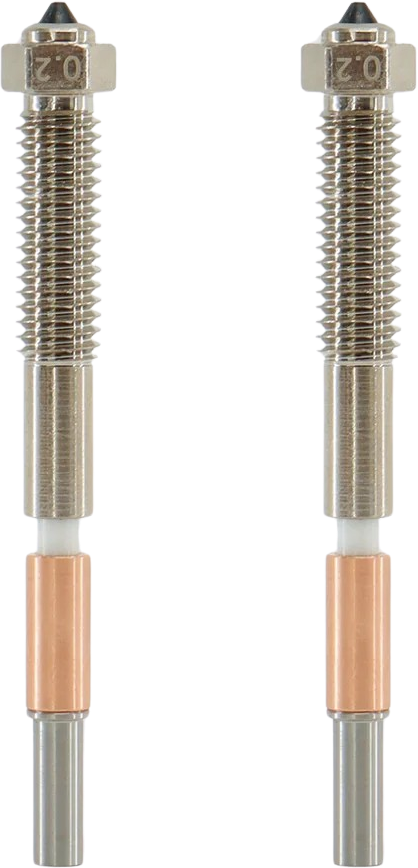
Replacement bimetal FDM nozzle set for Max4 · 2 x 0.2 mm · Max4
QIDI Tech

Replacement bimetal FDM nozzle set for Plus4 · 2 x 0.2 mm · Plus4
QIDI Tech
A 0.6 mm nozzle for terrain
For ruins, buildings, hills and storage trays, a 0.6 mm nozzle is the common upgrade: wider lines fill large walls in fewer passes. Detail on flat terrain survives well at this size; it is the very small features that soften. For which filament to print it in, see the best filament for terrain and miniatures.
Replacement bimetal FDM nozzle set for Q2 · 2 x 0.6 mm · Q2
QIDI Tech

Replacement bimetal FDM nozzle set for Plus4 · 2 x 0.6 mm · Plus4
QIDI Tech
Brass or hardened steel?
Prusa's nozzle article says brass "has excellent heat conductivity and is tough enough to print most common filaments", but "when using abrasive filaments, the brass nozzle tends to wear too quickly". Abrasive filaments are the ones with hard fillers: carbon-fibre and glass-fibre blends, and Prusa also names glow-in-the-dark material among the ones its abrasion-resistant ObXiDian 500 nozzle is meant for (Prusa Nextruder nozzle types).
For PLA, PETG and TPU, brass is fine. If you plan to print carbon-fibre PLA or PETG, check your printer's nozzle first. Bambu Lab's P2S ships with a hardened steel nozzle (P2S specifications); its A2L ships with stainless steel and Bambu says to fit a hardened steel nozzle for PLA-CF and PETG-CF (A2L specifications); and Bambu advises against fibre-reinforced filament on the P1S until the extruder and hotend are upgraded (Bambu Lab P1 page). Our Bambu Lab P1S vs P2S guide sets those two printers side by side.
Hardened-steel nozzles for abrasive filament on the Neptune 4 series (Type-C toolhead) · Fits Neptune 4, 4 Pro (Type-C), 4 Plus, 4 Max
ELEGOO

Replacement 0.4mm nozzles in brass (everyday PLA/PETG) and hardened steel (abrasive carbon/glass-fibre filament) for the Centauri printers · 0.4mm · Fits Centauri, Centauri Carbon series
ELEGOO

Replacement tungsten-carbide bimetal FDM nozzle for Q2 · 0.4 mm · Q2
QIDI Tech
Other abrasion-resistant materials do the same job: tungsten carbide, and E3D's diamond-tipped DiamondBack, which Prusa lists for "engineering-grade metal and ceramic-filled filaments".
Match the nozzle to your printer
A nozzle is not a universal part. Makers sell a separate nozzle for each printer family (screw-in, quick-swap, or sold with its heatbreak), which is why the cards above name the printers each one fits. On the nozzles shelf, the "fits my printer" filter narrows the list to your machine.
When you change nozzle size, change the slicer profile too. The printer cannot tell what is fitted, so a 0.6 mm nozzle printed with 0.4 mm settings under-extrudes.
Questions
What nozzle size is best for miniatures?
On a filament printer, 0.2 or 0.25 mm gives the finest detail, at the cost of much longer prints. For 28 mm infantry, a resin printer shows more detail than any filament nozzle.
What nozzle size is best for terrain?
0.4 mm, the standard size, suits almost all terrain. A 0.6 mm nozzle prints large buildings and storage faster with thicker lines.
Do I need a hardened steel nozzle?
Only for abrasive filaments, such as carbon-fibre and glass-fibre blends. Prusa says brass is tough enough for most common filaments but wears too quickly on abrasive ones.
Is hardened steel worse than brass?
Prusa describes brass as having excellent heat conductivity and recommends it for non-abrasive filaments. Keep brass for PLA and PETG, and use an abrasion-resistant nozzle only where the filament needs it.
We compare what the printer makers publish and the prices at the shops we track; we have not fitted or printed with these nozzles ourselves.