
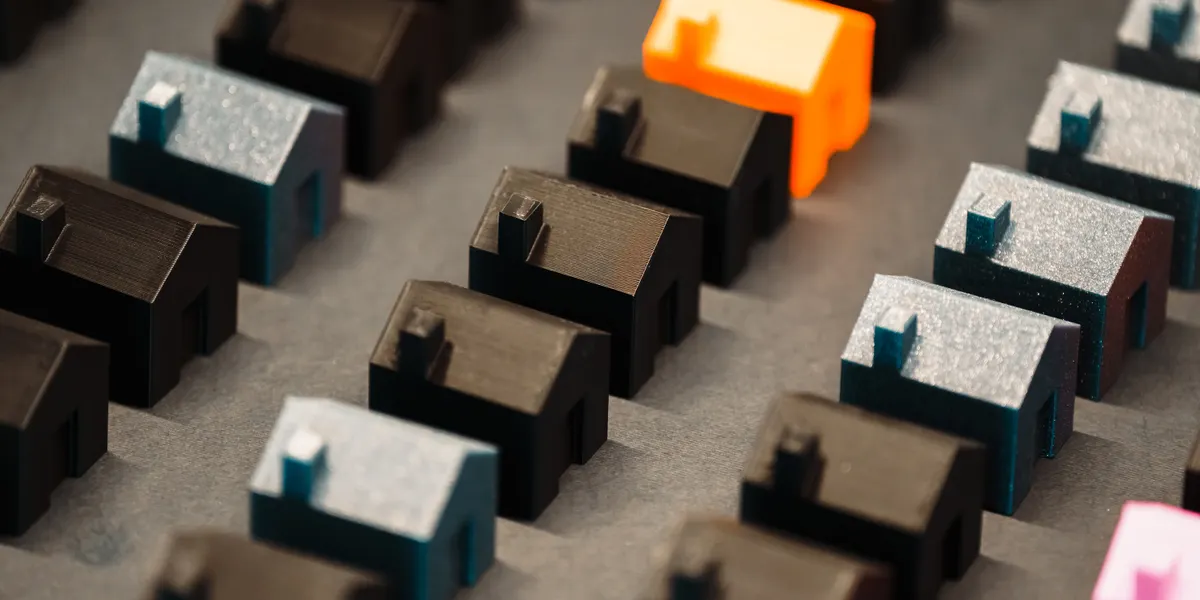
For most wargaming terrain, bases and scatter, the best filament is a matte or plain PLA in grey: it is the easiest to print on any open printer, holds sharp detail and takes primer like a plastic kit. Move to PLA+ for thin pieces that get handled, PETG for terrain that travels or lives somewhere warm, ASA for anything in the sun (on an enclosed printer), and TPU for parts that bend. These are 1 kg spools of each that the shops we compare sell, priced in your market:

Matte PLA filament that hides layer lines · 1kg
ELEGOO

Matte PLA filament tuned for high-speed printers; hides layer lines · 1kg
QIDI Tech

Standard PLA filament: the easiest material for terrain, props and display pieces · 1kg
SUNLU

Tougher, less brittle PLA+ filament · 1kg
ELEGOO

PETG filament tuned for high-speed printers · 1kg
ELEGOO

Flexible TPU 95A filament · 1kg
ELEGOO
Why grey? A mid grey shows the detail on the printer bed, so you can judge a print before you prime it, and it hides a missed spot of primer better than black or white. The colour does not change how the filament prints or paints; buy whatever suits you.
Every spool we compare is on the filament shelf, with its own pages for PLA, PETG and TPU. The settings for sixteen filaments are in our filament temperature chart.
Which filament for 3D printed terrain, bases and minis
| Job | Best filament | Why |
|---|---|---|
| Ruins, buildings, scatter and bases | Matte PLA or PLA | Easiest to print, crisp detail, primes like a plastic kit |
| Thin spires, railings, gantries | PLA+ | Same settings as PLA, but tougher where plain PLA snaps |
| Club terrain, case inserts, paint racks | PETG | Tougher and copes with more heat; prints on an open printer |
| Terrain or displays in the sun or a hot car | ASA | UV resistant and the most heat-tolerant here; needs an enclosure |
| Tank tracks, banners, cables, tray liners | TPU | Flexible, so it bends instead of breaking |
| Crates, planking, stone and display bases | Wood, marble or silk PLA | A surface that looks finished before paint |
| 28 mm infantry and characters | Resin, not filament | Faces and hands come out sharper on a resin printer |
The makers' figures side by side
Each maker publishes its own settings, and eSUN publishes a heat distortion temperature (the point where a loaded part starts to bend) for most of its lines, which gives one fair comparison of how much heat each material takes. These are eSUN's figures from its PLA-Basic, PLA+, ePLA-Matte, PETG, ASA+, ABS and eTPU-95A pages:
| Filament | Nozzle | Bed | Enclosure | Heat distortion |
|---|---|---|---|---|
| PLA | 210-230 °C | 45-60 °C | Not needed | 54 °C |
| Matte PLA | 190-230 °C | 45-60 °C | Not needed | 51 °C |
| PLA+ | 210-230 °C | 45-60 °C | Not needed | 54 °C |
| PETG | 240-260 °C | 75-90 °C | Not needed | 64 °C |
| ABS | 255-275 °C | 95-110 °C | Yes | 78 °C |
| ASA | 250-280 °C | 90-110 °C | Yes | 96 °C |
| TPU (95A) | 220-250 °C | 45-60 °C | Not needed | Not stated |
Other brands print in the same ranges, but your spool's label is the setting to start from. Prusa adds that PLA "gets soft and deforms at temperatures over 60 °C" (Prusa: PLA), which is the practical line between terrain that can sit in a hot car and terrain that cannot.
Best filament for terrain: PLA
PLA is the default because it asks the least of you and your printer. It prints at the lowest temperatures of the common filaments, barely warps, needs no enclosure and holds the edges of a brick wall or a ruined window sharply. It is the easiest of the common filaments to get right first time. The trade-off is that it is stiff and brittle, and it softens above 60 °C.
Plain PLA from the big printer makers is sold in every market we cover:

PLA filament: the easiest material for terrain, scenery, props and display pieces · 1kg
ELEGOO
Standard PLA filament: the easiest material for terrain, props and display pieces · 1kg
SUNLU

PLA filament: the easiest material for terrain, scenery, props and display pieces · 1kg
QIDI Tech

PLA filament: the easy all-rounder for terrain, bases and display prints · 1kg, 1.75 mm
Creality
PLA filament: the easy all-rounder for terrain, bases and display prints · 1kg, 1.75 mm
Bambu Lab

1.75 mm PLA filament for FDM printers · 1kg spool, 1.75 mm
eSUN
Matte PLA, if you will paint it
Matte PLA is the one we would point a painter to first. Its flat surface shows layer lines less under a thin coat of primer and paint than glossy PLA does, and it prints on the same open printer. eSUN gives its matte line a slightly lower nozzle range (from 190 °C) and a heat distortion figure of 51 °C, so treat it as a little more heat-shy than plain PLA.
Matte PLA filament that hides layer lines · 1kg
ELEGOO
Matte PLA filament tuned for high-speed printers; hides layer lines · 1kg
QIDI Tech

Matte PLA filament that hides layer lines · 1kg
SUNLU

PLA · 1kg · 1.75 mm · Matte Grey
Creality
Matte PLA: hides layer lines and takes primer well, a good base for painted miniatures and terrain · 1kg, 1.75 mm
Bambu Lab

1.75 mm PLA filament for FDM printers · 1kg spool, 1.75 mm
eSUN
PLA+ for terrain that gets handled
PLA+ (or PLA Pro) is a maker's own tougher PLA. There is no standard for the plus, so each brand's is different, but eSUN's own figures show what it can change: its PLA+ takes more than twice the Izod impact of its PLA-Basic (7.27 against 3.25 kJ/m²) on identical print settings, with the same heat distortion. That is the filament for gantries, spires, railings and antennae that snap in plain PLA. It does not make PLA any more heat-proof. Our PLA vs PLA+ guide has the full comparison.
Tougher, less brittle PLA+ filament · 1kg
ELEGOO

Tougher, less brittle PLA filament · 1kg
ELEGOO

Tougher, less brittle PLA+ filament · 1kg
SUNLU

1.75 mm PLA filament for FDM printers · 1kg spool, 1.75 mm
eSUN

Tougher, less brittle PLA+ filament · 1kg
Anycubic
PETG for terrain that travels
PETG is tougher than PLA and takes more heat: eSUN puts its PETG at 64 °C heat distortion against 54 °C for its PLA, and Prusa recommends it for mechanical parts "for both indoor and outdoor use". For a wargamer that means club terrain that is packed every week, foam-tray replacements and carry-case inserts, paint racks, and storage on a sunny windowsill. It still prints on an open printer.
It strings more than PLA and prints hotter, on a hotter bed. Prusa warns it can bond too hard to a smooth PEI sheet, so print it on a textured plate or use glue stick as a release layer (our textured vs smooth PEI guide explains why). The full comparison is in PETG vs PLA.
PETG filament tuned for high-speed printers · 1kg
ELEGOO

PETG filament: tougher and more heat-tolerant than PLA, easy to print · 1kg
ELEGOO

PETG filament: tougher and more heat-tolerant than PLA, easy to print · 1kg
SUNLU

PETG / co-polyester filament: tougher and more heat-resistant than PLA, still easy to print · 1kg, 1.75 mm
Creality

PETG filament: tougher and more heat-tolerant than PLA, easy to print · 1kg
QIDI Tech

1.75 mm PETG filament for FDM printers · 1kg spool, 1.75 mm
eSUN
ASA and ABS, for heat and sun
ASA has the highest heat distortion figure in the table, 96 °C on eSUN's numbers, and Prusa calls it "more UV resistant" than ABS, with less warping and less smell. That suits a garden gaming table, a display in a sunny window, and terrain that rides in a hot car all summer. ABS is tougher on eSUN's impact figures and can be smoothed with acetone vapour, which suits a glossy vehicle hull.
Both need an enclosed printer: eSUN and Prusa each call for one. On an open printer, print PETG instead. Our ASA vs ABS and PLA vs ABS guides go through them, and do you need a 3D printer enclosure covers the hardware.

UV- and weather-resistant ASA filament for outdoor parts · 1kg
ELEGOO

ASA filament: UV- and weather-resistant, prints like ABS · 1kg
QIDI Tech

ASA filament: UV- and weather-resistant, for outdoor parts; needs a heated bed and ideally an enclosure · 1kg, 1.75 mm
eSUN

ABS filament: tougher and more heat-resistant than PLA, needs a heated bed and ideally an enclosure · 1kg
ELEGOO

ABS-family filament: tougher and more heat-resistant than PLA, needs a heated bed and ideally an enclosure · 1kg, 1.75 mm
Creality
TPU for parts that bend
TPU is a flexible filament. Print tank tracks, banners and cables that bend instead of snapping, flexible bases, and soft liners for a dice tray or a case. eSUN asks for a direct-drive extruder and slow printing for its eTPU-95A, and Prusa says to keep part cooling off for flexibles, so check your printer's extruder before you buy a spool. The 95A on the label is its hardness: lower numbers are softer.

Flexible TPU 95A filament tuned for faster printing · 1kg
ELEGOO
Flexible TPU 95A filament · 1kg
ELEGOO

1.75 mm flexible filament for FDM printers · 1kg spool, 1.75 mm
eSUN

Flexible TPU 95A filament · 1kg
Anycubic
Wood, marble and silk PLA for display pieces
Specialty PLAs give a finish before any paint. Wood-fill prints crates, barrels and planking that can be sanded and stained; marble and stone-effect PLA suits plinths and display bases; silk PLA has a glossy sheen for trophies and objective markers left unpainted. Prusa notes wood-filled filament wants a 0.6 mm nozzle or larger, so a standard 0.4 mm nozzle can clog on it (see our nozzle size guide).

Wood-filled PLA filament with a real-wood texture, good for terrain · 1kg
SUNLU

Wood-filled PLA filament with a real-wood texture, good for terrain · 1kg
ELEGOO


PLA with a stone-like marble fleck, good for terrain and bases · 1kg
ELEGOO

High-speed PLA with a stone-like marble fleck, good for terrain and bases · 1kg
SUNLU

High-gloss silk-finish PLA filament for display pieces · 1kg
ELEGOO
Carbon-fibre and glass-fibre filled spools (PLA-CF, PETG-CF) are stiffer and hide layer lines well, but Prusa says they are abrasive and need a hardened nozzle. They suit hobby jigs and display stands more than detailed terrain.
Best filament for miniatures
If you want to print 28 mm or 32 mm miniatures, the honest answer is resin, not filament. A filament printer lays down lines of plastic around 0.4 mm wide, so faces, hands and fine weapons come out softer than on a resin printer, and supports leave more marks. Filament is very good at the bigger things: vehicles, walkers, monsters, bases and terrain. Our resin vs FDM guide explains the trade-off, and best resin for miniatures compares the resins.
If you do print figures on a filament printer, use a matte PLA, a smaller nozzle (0.2 or 0.25 mm) and fine layers, and print one model at a time. A resin starting point, for comparison:

General-purpose UV printer resin: the baseline chemistry, not water-washable · 1000g
ELEGOO

Water-washable UV printer resin tuned for 8K-display printers, second-generation formula · 1000g
ELEGOO

Water-washable ABS-like UV printer resin, combining easy clean-up with ABS-like toughness · 1000g
ELEGOO
Painting prints and keeping spools dry
Every filament here takes acrylic paint once it is primed. Sand the layer lines on flat walls first if they bother you, prime with a spray or brush-on primer made for plastics, and then paint as you would a plastic kit. Our how to paint 3D prints and sanding 3D prints guides cover each step. A grey primer suits most terrain, and a primer with a filler in it fills fine layer lines as it goes:
AK Interactive
Army Painter
AK Interactive
Vallejo
Most filament takes on moisture once the bag is open, and a damp spool strings and prints rough, weak walls. PETG and TPU suffer more than PLA. Prusa dries PLA at 45 °C for six hours, PETG at 55 °C and TPU at 60 °C. A dryer rescues a damp roll and a sealed box keeps it dry: see our filament dryer guide and filament storage guide.

Filament dryer box that bakes moisture out of a spool
ELEGOO

Filament dryer for four spools, two independent heating chambers · 75 C
Creality

Single-spool filament dryer you can print from while it dries
SUNLU

Filament dryer for four spools, two independent 200W PTC chambers, desiccant regeneration · 85 C
Creality
To see what a piece of terrain costs in each filament, try the 3D print cost calculator.
The filament comparisons in full
- PETG vs PLA: the two open-printer filaments for terrain
- PLA vs PLA+: what the plus buys you, on one maker's figures
- PLA vs ABS: the easy filament against the tough one
- ASA vs ABS: the UV-resistant successor to ABS
Questions
What is the best filament for 3D printers?
For most people, PLA. It prints on any open printer at low temperatures, barely warps and holds fine detail. Choose PETG for tougher parts that take more heat, ASA for sun and heat on an enclosed printer, and TPU for parts that need to flex.
What is the best filament for 3D printing terrain?
Matte or plain PLA for most terrain. It is the easiest filament to print, needs no enclosure, holds sharp detail and primes like a plastic kit. Use PETG for pieces that are handled, transported or kept somewhere warm.
What is the best filament for printing miniatures?
For 28 mm infantry, resin gives far sharper faces and hands than any filament. On a filament printer, matte PLA with a 0.2 or 0.25 mm nozzle and fine layers gives the best detail, and filament is very good for vehicles, monsters and bases.
Is PLA or PETG better for wargaming terrain?
PLA for most terrain, because it prints most easily and keeps detail crisp. PETG is tougher and takes more heat (64 °C against 54 °C heat distortion on eSUN's figures), so it suits club terrain and anything packed and carried often.
Does filament colour matter for painting?
Not for how it prints or paints. A mid grey shows detail on the printer and hides gaps in the primer, which is why grey is a common choice for terrain that will be painted.
Do I need an enclosed printer?
Not for PLA, PLA+, PETG or TPU. eSUN and Prusa both call for an enclosure for ABS and ASA.
We compare the makers' published figures and the prices at the shops we track; we have not printed with these spools ourselves.