
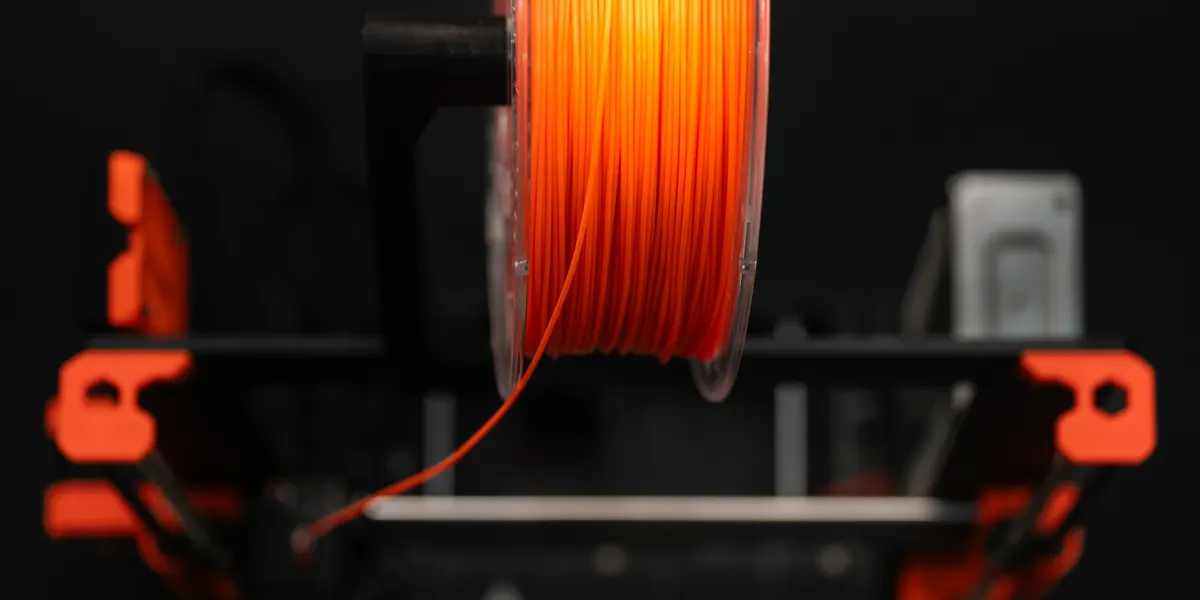
PLA+ is PLA its maker has modified to be tougher. It prints on the same settings and the same open printer, and it is worth it for terrain that gets handled: thin spires, railings and gantries that plain PLA might snap. For scenery that sits on a shelf or a table, plain PLA does the job. There is no standard for the "+": each maker sets its own formula, so one brand's PLA+ is not another's. These are 1 kg spools of plain PLA and PLA+ from the same three makers, Elegoo, SUNLU and eSUN, so you can compare each brand's two side by side on price:

PLA filament: the easiest material for terrain, scenery, props and display pieces · 1kg
ELEGOO

Tougher, less brittle PLA+ filament · 1kg
ELEGOO

Standard PLA filament: the easiest material for terrain, props and display pieces · 1kg
SUNLU

Tougher, less brittle PLA+ filament · 1kg
SUNLU
Both are on the PLA filament page, where PLA+ and Pro lines are a filter, priced per kilo in your currency. Print settings for PLA, PLA+ and fourteen other filaments are in our filament temperature chart.
PLA vs PLA+ at a glance, on one maker's figures
Because each maker's PLA+ is its own, the fair comparison is one maker's plain PLA against the same maker's PLA+. eSUN publishes the same test figures for both on its PLA-Basic and PLA+ pages:
| eSUN PLA-Basic | eSUN PLA+ | |
|---|---|---|
| Nozzle temperature | 210-230 °C | 210-230 °C |
| Bed temperature | 45-60 °C | 45-60 °C |
| Part cooling fan | 100% | 100% |
| Impact strength, Izod (XY) | 3.25 kJ/m² | 7.27 kJ/m² |
| Tensile strength (XY) | 64.3 MPa | 70.4 MPa |
| Heat distortion | 53.7 °C | 53.8 °C |
| Drying | 50 °C for 8-12 hours | 50 °C for 8-12 hours |
So on eSUN's numbers, PLA+ prints exactly like its PLA, takes more than twice the impact before it breaks, is a little stronger in tension, and copes with heat no better. eSUN describes it as "stronger and tougher than standard PLA, resisting breaks from handling or minor bumps". Other brands' PLA+ may differ in every row; their spool label and product page are the figures to trust.
What the plus does and does not do
It makes PLA less brittle. Plain PLA is stiff and snaps; Prusa says it "breaks along layers or into shards upon impact". A tougher PLA+ survives the knocks a terrain piece takes in a game or a figure case: a gantry caught by a sleeve, a ruin dropped off the table edge.
It does not make PLA heat-proof. eSUN's heat distortion figures are within a degree of each other, and Prusa says PLA softens above 60 °C. A PLA+ print left in a hot car can sag just like PLA. For heat, look at PETG, or ASA on an enclosed printer.
It does not change how you print. eSUN gives the same nozzle, bed and fan settings for both. Other makers set their own figures for their PLA+, which is why the label matters.
The PLA shelf files tough, impact-modified and high-temperature PLA lines under PLA+ as well (Elegoo PLA Pro, SUNLU PLA Meta, HT-PLA). High-temperature PLA is the exception to the heat point above: it is a different formula sold for heat, so read its maker's figures.

Tougher, less brittle PLA filament · 1kg
ELEGOO

PLA Meta filament in soft macaron colours · 1kg
SUNLU

Tougher PLA+ filament tuned for high-speed printers · 1kg
ELEGOO
When to buy which
- Plain PLA for most terrain, scatter, bases and display pieces, and for test prints. It holds crisp detail and is the easiest filament to print.
- PLA+ for terrain that travels or gets handled, thin or tall parts, clips and pegs, and anything you have snapped in plain PLA before.
- Neither for parts that must survive heat or real mechanical stress: that is PETG, ABS or ASA territory. See PETG vs PLA and PLA vs ABS.
Painting PLA and PLA+
Both prime and paint like a plastic kit: the same spray or brush-on primer, then acrylics, step by step in how to paint 3D prints. Our spray primer guide compares the cans.
Keep it dry
eSUN dries both at 50 °C for 8 to 12 hours; Prusa dries its own PLA at 45 °C for six hours. A damp spool of either strings and prints rough walls. See our filament storage guide and filament dryer guide. Our 3D print cost calculator shows what the plus adds to the cost of a print, from the spools sold in your region.
Other filament comparisons
- Best filament for terrain and miniatures: every material in one table, with the spools to buy
- PETG vs PLA: the tougher, more heat-tolerant step up
- PLA vs ABS: the easy filament against the tough one
- PETG vs ABS: toughness without the enclosure
- ASA vs ABS: the UV-resistant successor to ABS
- Silk PLA vs PLA: the shiny finish for display pieces, and why painted terrain stays plain
Questions
Is PLA+ stronger than PLA?
Tougher, mainly. On eSUN's own figures its PLA+ takes more than twice the Izod impact of its PLA-Basic and is about 10% stronger in tension. Other makers' PLA+ differs, because there is no standard formula.
Does PLA+ need different settings?
eSUN gives the same settings for both, 210-230 °C at the nozzle and a 45-60 °C bed. Other brands set their own figures, so start from the spool label.
Is PLA+ more heat resistant than PLA?
Not usually. eSUN's heat distortion figures for its PLA and PLA+ are within a degree of each other. High-temperature PLA lines are sold for heat; for terrain left somewhere warm, PETG is the usual choice.
Is PLA Pro the same as PLA+?
Makers use both names for their own tougher PLA, and eSUN's PLA+ page itself is titled PLA Plus and PLA Pro. Treat each as that brand's formula and read its figures.
We compare the makers' published figures and the prices at the shops we track; we have not printed with these spools ourselves.