
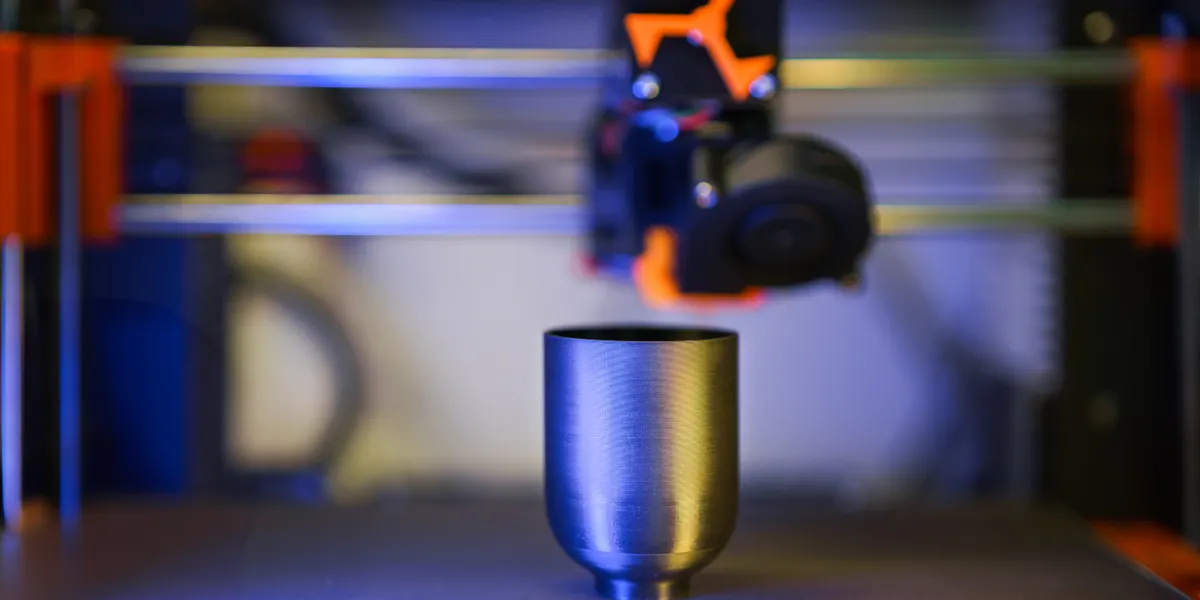
Silk PLA is PLA with a glossy, metallic-looking finish that hides layer lines. Use it for pieces you will leave unpainted: objective markers, trophies, display plinths, a golden statue for a ruined temple. Use plain PLA for terrain you will prime and paint, because the paint covers the shine you paid for. Silk PLA is also weaker. On eSUN's own figures, its PLA-Silk has about half the tensile strength of its PLA-Basic.
These are silk spools in the metal colours most useful on a gaming table, and plain PLA from the same makers, as sold by the shops we track:

High-gloss silk-finish PLA filament for display pieces · 1kg
ELEGOO

High-gloss silk-finish PLA filament for display pieces · 1kg
QIDI Tech

PLA (silk) · 1kg · 1.75 mm · Silver
Creality

PLA filament: the easiest material for terrain, scenery, props and display pieces · 1kg
ELEGOO

PLA filament: the easiest material for terrain, scenery, props and display pieces · 1kg
QIDI Tech
Every spool we compare is on the PLA filament page, where silk is one of the finish filters, priced per kilo in your currency. Print settings for silk PLA and fifteen other filaments are in our filament temperature chart.
Silk PLA vs PLA at a glance, on one maker's figures
Each maker blends its silk PLA its own way, so the fair comparison is one maker's plain PLA against the same maker's silk. eSUN publishes the same test figures for both on its PLA-Basic and PLA-Silk pages:
| eSUN PLA-Basic | eSUN PLA-Silk | |
|---|---|---|
| Nozzle temperature | 210-230 °C | 190-230 °C |
| Bed temperature | 45-60 °C | 45-60 °C |
| Part cooling fan | 100% | 100% |
| Tensile strength (XY) | 64.3 MPa | 32.53 MPa |
| Impact strength, Izod (XY) | 3.25 kJ/m² | 2.93 kJ/m² |
| Heat distortion | 53.7 °C | 50 °C |
| Finish | Plain, layer lines visible | Silky gloss, eSUN says with "no visible layer lines" |
So on eSUN's numbers, silk PLA prints on the same bed and fan settings, can run a little cooler at the nozzle, is about half as strong in tension, a little more brittle, and softens a few degrees sooner. What you get in return is the surface. Other brands' silk may differ in every row; their spool label and product page are the figures to trust.
What silk PLA is good for on a gaming table
Silk PLA is a finish, not a material upgrade, so use it where the finish is the point and nothing will be painted over it.
- Objective markers and tokens that read as gold, bronze or brass from across the table.
- Trophies and display plinths for a painted model or a tournament prize.
- Statues, idols and relics set into terrain, printed in gold or bronze so they stand out from the painted scenery around them.
- Dice towers and display stands that sit on a shelf and get looked at more than handled.
The metal colours are the useful ones for this. Gold, silver and bronze silk are sold by the shops we track in all five of our markets; copper and brass in fewer.
High-gloss silk-finish PLA filament for display pieces · 1kg
QIDI Tech
High-gloss silk-finish PLA filament for display pieces · 1kg
QIDI Tech
High-gloss silk-finish PLA filament for display pieces · 1kg
ELEGOO
Why plain PLA for terrain you paint
For ruins, buildings, crates and bases that you will prime and paint, silk adds nothing and costs strength. Primer covers the gloss completely, and it is the primer and paint that the eye sees. Plain PLA, on eSUN's figures, is about twice as strong in tension, which matters for thin walls, railings and spires that take knocks in a game.
Silk spools also tend to cost more per kilo than plain PLA from the same maker. Compare the per-kilo price on the PLA shelf in your currency. If you want a surface that shows layer lines less under a thin coat of paint, matte PLA is made for that job.

Matte PLA filament that hides layer lines · 1kg
ELEGOO

Standard PLA filament: the easiest material for terrain, props and display pieces · 1kg
SUNLU

PLA filament: the easy all-rounder for terrain, bases and display prints · 1kg, 1.75 mm
Creality

PLA filament tuned for high-speed printers · 1kg
QIDI Tech
Printing silk PLA
Silk PLA prints on any printer that prints PLA, on the same bed, with no enclosure. eSUN's notes for its PLA-Silk add three things:
- Slow the outer walls. eSUN says that "excessive printing speed can reduce surface gloss", so slow the outer-wall speed for more shine.
- Keep the fan up for overhangs. eSUN says silk "has slightly poorer cooling performance than regular PLA" and needs a higher fan speed on overhangs.
- Watch the room temperature. eSUN recommends keeping an enclosure open for any PLA, so the chamber does not get too warm.
The sheen changes with the angle of the light, so it shows most on curved surfaces: a statue, a round plinth, a dome.
Dual-colour and rainbow silk
Dual and tri-colour silk spools have two or three colours in one strand, so each face of a print shows a different colour depending on where you stand. On a gaming table that suits a display piece, a trophy or a magical relic, rather than terrain. Rainbow silk changes colour along the spool instead, so one print fades from one colour to the next.
High-gloss silk-finish PLA filament for display pieces · 1kg
ELEGOO
High-gloss silk-finish PLA filament for display pieces · 1kg
ELEGOO
High-gloss silk-finish PLA filament for display pieces · 1kg
ELEGOO
High-gloss silk-finish PLA filament for display pieces · 1kg
ELEGOO
Can you paint silk PLA?
Yes. It primes and paints like any PLA once it is clean and primed, though the glossy surface gives primer less to key into, so let a plastic primer cure fully before you handle it. But if a piece is going to be painted all over, print it in plain or matte PLA and keep the silk spool for what will stay bare. Our how to paint 3D prints guide covers primers and paints for PLA, and the spray primer guide compares the cans.
Silk PLA, PLA+ and PETG
Silk PLA sits at the opposite end from the tougher filaments. PLA+ is PLA made tougher for terrain that gets handled; PETG is tougher again and copes with more heat. Some makers sell a silk finish on a PLA+ base, such as SUNLU's Silk PLA+; read that maker's own figures rather than assuming it is as tough as their plain PLA+.
Keep it dry
Silk PLA picks up moisture like any PLA, and a damp spool strings and prints a rough, dull surface, which defeats the point of silk. A sealed box with desiccant keeps a dry spool dry; see our filament storage guide and filament dryer guide. Our 3D print cost calculator shows what a silk spool adds to the cost of a print, from the spools sold in your region.
Other filament comparisons
- PLA vs PLA+: what the plus changes
- PETG vs PLA: the tougher, more heat-tolerant step up
- PLA vs ABS: the easy filament against the tough one
- PETG vs ABS: toughness without the enclosure
- ASA vs ABS: the UV-resistant successor to ABS
Questions
Is silk PLA weaker than normal PLA?
On eSUN's own figures, yes. Its PLA-Silk has a tensile strength of 32.53 MPa against 64.3 MPa for its PLA-Basic, and slightly lower impact strength. Other makers' silk may differ, so read the spool's own figures.
Is silk PLA good for terrain?
For terrain you will paint, no. Primer covers the shine and plain PLA is stronger. Silk PLA suits unpainted display pieces such as objective markers, trophies, plinths and statues.
Does silk PLA need different print settings?
eSUN gives the same bed and fan settings as its plain PLA and a nozzle range of 190-230 °C. It recommends slowing the outer walls for more gloss and keeping the fan high on overhangs.
Can you paint silk PLA?
Yes, once it is clean and primed. The glossy surface gives primer less to grip, so let a plastic primer cure fully. If a piece will be painted all over, plain or matte PLA is the better choice.
Does silk PLA hide layer lines?
It hides them better than plain PLA. eSUN describes its PLA-Silk as having a silky gloss with no visible layer lines.
We compare the makers' published figures and the prices at the shops we track; we have not printed with these spools ourselves.